

I sometimes say that 2004 felt more like 1994 than like 2008.
This is most obvious in technology: by 2008, YouTube and iPhones had both taken off. In 2004, I was in college and still had a landline, which I used to make three phone calls with any regularity: girlfriend, dad, and Pitchfork. It was a weird time; the internet had sort of arrived, especially if you were in college with a fast connection, but it wasn’t yet quite a thing you could take for granted. Social media was for the most part still in its prehistory. The most reliable forms of rapid response in online communication (email and message boards) and direct media access (file sharing) were the same forms that I was familiar with in the late ‘90s, just slightly more expansive and growing every day.
I think of that period, 2004-2008, as an interzone, after Alfred Soto’s term for the period of US popular culture between 1988-1993, the Poppy Bush Interzone. Here’s Soto:
[T]he Poppy Bush Interzone (PBI) comprised a period in American pop music a product of and detached from history. It encompasses the fall of 1988 until the fall of 1993, a period just before and just after Bush’s term in office. Decades aren’t walls of mortar. The increasing visibility on MTV of British acts borne of punk and post-punk resulted in greater crossover radio play. This was the era when The Cure, Depeche Mode, Morrissey, New Order, and Siouxsie and the Banshees enjoyed their dominance; so did Psychedelic Furs (in many ways this era’s John the Baptizer), Echo & the Bunnymen, XTC, and members of Bauhaus, among others. Chris Molanphy has written well about this era. I should note too that my nomenclature owes a debt to critic Ned Raggett, who on the ILX message board years ago first used “interzone” as descriptor.
By contrast, the pop chart reflected the dominance of the decade’s biggest marquee draws. Taking advantage of Michael Jackson and Bruce Springsteen’s silence after the last singles from Bad and Tunnel of Love, respectively, had peaked, Madonna and Janet Jackson entered a new chart and critical ascendancy. Prince hung in there. Lionel Richie chose silence. In their wake rushed a slew of imitators: Karyn White, Paula Abdul, Milli Vanilli. Although boomer rock acts had adapted to Contemporary Hits Radio during the High Reagan Years, the sudden importance of VH-1 gave the Doobie Brothers, Paul McCartney, the Traveling Wilburys axis, and especially the Rolling Stones another medium on which to preen for viability. Thus, you had the phenomenon of “Mixed Emotions” and “Miss You Much” played within minutes of each other, or “Free Fallin’” beside Michael Penn’s “No Myth.” Fine Young Cannibals landing a #1 album and two #1 singles? Purest PBI. Listeners over the age of thirty-five may remember the PBI as the years when the Beatles catalog in its American compact disc pressings finally saw the sequencing — hence integrity and gestalt — of the original albums restored. World Party, Matthew Sweet, Jellyfish, and less remembered imitators profited.
I can’t really speak to the veracity of Soto et al.’s account of this particular interzone. ‘88-’93 are formative years for me (circa ages 4-8), but I was also a little kid and not well equipped to notice structural changes, while my nostalgia also keeps me from thinking about it too far outside of that personal lens.
But I can say that there is a definite interzone feel in the “Sonny Bush” period. About ten years ago I even considered outlining a book about this period, chronicling different music acts starting in 2004 and ending with the 2008 election. It was modeled on Love Goes to Buildings on Fire, the book by Will Hermes that chronicled changes in disco, rap, salsa, and rock in New York City between 1973 and 1977. At the time, my first thoughts for major stories were indie (Arcade Fire), rap (Kanye West), art-pop (M.I.A.), and either pop (Britney Spears) or maybe confessional teenpop (Ashlee Simpson). Now I think I’d probably want any book like this also to focus on reggaeton or dancehall, which are well outside my own expertise.
I do think the broad strokes of these stories are all still interesting, and many stories have been told in the interim. Chris DeVille’s Such Great Heights captures the indie boom; Britney Spears has had documentary treatment of her reception during this period and general understanding of the tabloid nadir has changed a lot. I think the appetite for diving deep into three out of four of these acts is complicated by their present-day controversies, but I think you could probably tell plenty of stories with a wider lens without focusing on them specifically. (For instance, someone should do a 33 1/3 style book on Hyphy Hitz.)
It’s a little strange to me that I find this four-year period easier for me to historicize than more than a decade of music history that followed, where I feel like I missed most of the biggest stories outside of the US and broader Anglosphere. But that’s probably someone else’s book to write; I’m still following the breadcrumbs backward to try to figure it out myself. I might still write the confessional teenpop book some day, though.
1. YENA: Catch Catch
South Korea
Two big K-pop singles leading mixes already in the first quarter of the year (this and KiiiKiii’s “404 (New Era)”), is that better than last year? I can never tell how any particular style is faring with this newsletter. God knows I don’t keep track of anything in my head; that’s what the spreadsheets are for. But between I-liked-it stuff like this big new YENA single—which an online K-pop chat friend connects spiritually to the 2011 2nd gen heyday (when YENA herself would have been about twelve)— and also the don’t-like-it-but-respect-the-hustle stuff from BLACKPINK and IVE, I think my claim last year that even a “bad year” for K-pop can’t hide its center of gravity is looking pretty good.
2. Say Now: Millions
UK
But if you need an older center of gravity, throwback millennial girl group Say Now has you covered. They’re still repping the pop couture from oh-four. Every time that I wonder why they’re not much bigger than they are, I remember that this was in fact over twenty years ago and that I am officially old enough to frequently wake up with mysterious aches from muscles I seem to have pulled in my sleep.
3. Wersow: Party Girl
Poland
I’ll have to hold my thoughts about words versus phonetics and whether this is a distinction in need of a collapse. Will quickly mention, though, that “business woman party girl” has to be said in exactly this way in exactly this song to work, whereas Wersow could have gotten away with many other line readings of “ha! ha! ha! ha!”
4. María Isabel: Suiza
Dominican Republic-US
Was charmed by this one even though my analytical faculties are stalling out at the usual embarrassed grimace and shrug while stammering something like “er…kind of a soca vibe in there maybe?”
5. Dziarma: Moment
Poland
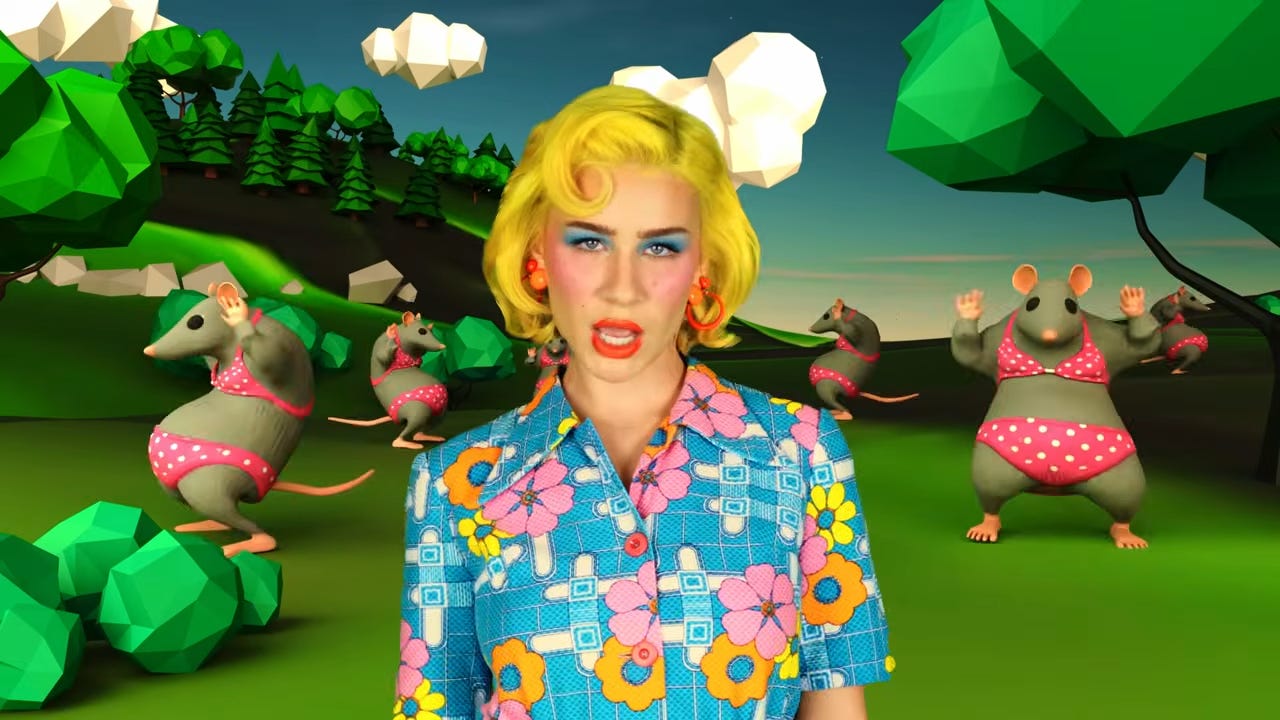
I have no such stalling issues with the Brazilian-inspired Polish weirdo-pop with hulking CGI rats dancing in pink polka-dot bikinis, which they do not look like they’re wearing for the first time today. You go, girls.
6. Raakasaga, Jokujekku: Paha Maine
Finland
Finnish rappers have some bass and a trap beat lying around and put on a show.
7. GRTSCH, Mon Laferte: Streetfighter
Mexico
8. Myaap: Beep Beep
US
Two joyrides. More peanut-butter-in-chocolate Latin/Caribbean crossover with bouyon (and maybe a little Balkan?) touches as a Mexican artist I’m finding hard to Google peels out. Glad to add Team GRTSCH to my badge collection next to Team Team Dresch. Then Myaap zips along, hand on horn, and drops references to previous hits like cursory glances in the rearview mirror.
9. Kuami Eugene: Scatter
Ghana
Afrobeats from a highlife singer who smuggles a party through a swamp of foreboding minor-key synths.
10. $ober, Shyron, MunH0: Sua Voce
Finland
Some phonk songs capture the fancy of the whole world while others flounder in triple-digit views. Such is life.
11. DJs Di Guetto, Dj Pausas: Mootoo (Remix)
Portugal
12. DJ Danifox: Mais Alto Que O Medo
Portugal
Two Príncipe (or -adjacent) picks, one from a wild album of avant-technno from DJs Di Guetto (click through the Bandcamp link) and the other a water-treading but pretty minimalist single from DJ Danifox.
13. Ploegendienst: Surinaamse Broodjes
Netherlands
Resident fact-checkers can let me know what else going on in this sharp, contemptuous Dutch punk song about the racist assumptions strangers make about where the subject is “from.” (“Why the fuck are you asking me where to get Surinamese sandwiches?”) All I really know is that I could hear “contemptuous” just fine through the language barrier and I’m glad I trusted my instinct not to sing along phonetically.
14. Mclusky: As a Dad
UK
Here’s one in English, and I couldn’t possibly tell you what it’s about even based on how it sounds. Turns out that’s because Mclusky did the smart thing and stole the chorus from a toddler.
15. Ragapop: Catharsis II
Ukraine
16. Deli Kate: Оз [Oz]
Ukraine
Two from Ukraine, post-punk with a hint of TV sync-ability, and then the sort of auto-pilot dance-pop that needs a sprinkle of fairy dust to signify, which this one has along with tossing in a wolf howl for good measure.
17. Evaya: Sprint
Portugal
My Eurovision country qualifier skimming hasn’t yielded a ton of gems, but my heart’s not really in it this year. This was the highlight from Portugal, synth-pop with a nice balance of moodiness and brightness.
18. ira4ma: Locket
Malaysia
Amazingly I did not get this directly from the billdifferen February roundup, but I checked back when the video looked familiar. I suppose that either means that Malaysian hyperpopper ira4ma has enough heat to make a few playlists or else I’m swiping from someone else with a similar taste profile. (Double checking now, I think it came from Ryan Dee’s playlist, so here is the requisite semi-yearly shout-out).
19. Sofia Kourtesis, Novalima: Los Poemas No Siempre Riman
Peru
I guess I’ve somehow gotten myself onto the Sofia Kourtesis street team? Here’s a track from her upcoming DJ-Kicks mix.
20. Styn: Rode Druif
Netherlands
Dutch techno hodgepodge that (according to the Bandcamp bio but also, to some minor extent, my ears) mixes hard techno with global styles — bubbling and (so it says but I didn’t really hear) batida. Whole album is good.
21. Souad Massi f. Youssoupha: Congo Connection
Algeria-France/DRC-France
A little world café for my own tastes, but there’s some heft to the arrangements and some tunes underneath—there’s a little more rock and funk elsewhere on the album.
22. V#, summerdayy: Chẳng Quan Tâm
Vietnam
23. Châu Bùi: Big Girl Don’t You Cry
Vietnam
Ending with two V-pop songs, both decent snapshots of the development of the pop scene there, which feels like it’s been holding its own with any other hyphenate you’d care to name. The videos, on the other hand, neither reach for the decadent heights of K-pop in its music video bloat era nor revel in the scrappy low-rent charm of Thai pop. Good thing I don’t care about videos!
That’s it! Until next time, recommend me some good recent music videos, I guess?
—Dave Moore (the other one)
Title from Say Now: Millions
V# (aka Vthang)'s whole playlist is generically good, like a stick of rock with "plugg" down the middle (If anyone still gets that reference. I haven't seen that kind of rock in a lifetime). Excellent use of autotune and choice of producers. The V Thang is Every Thang and Love Plugg EPs are a good place to dive in.