

I am usually on a one- to two-week delay with mixes, which means what I’m thinking about in the intro will often appear on the following mix. (NB: I also write these intros at least a week in advance, so you’ll only see a passing reference to the midterms in one of the blurbs below.) This past week I was thinking a lot about current Kenyan dancehall, which led me to learning more about gengetone, a style that emerged from the Kenyan genge hip-hop of the ‘90s and ‘00s. There will be a long suite of Kenyan music next week.
Kenyan dancehall seems to have entered its “psych era” (per Jonathan Bogart’s formulation) along with lots of other regional styles in the late ‘10s and into the ‘20s. “Psych era” is a shorthand for a wild period of rapid development, experimentation, and cross-pollination from other styles. Jonathan was the one who drew my attention to it, though Kenya’s unique pop scene—which seems to be on its own wavelength somewhere below the global popularity of the Nigerian and South African music that I pay more attention to—is something I’ve noticed in my mix-making for a few years, never quite getting a handle on it.
I don’t know much about the history of gengetone or its big resurgence around 2020, which captured some music press attention at the time, but only briefly, as far as I can tell. PAM has an excellent article from 2025 that explains some of this resurge and then a re-resurgence after the gengetone boom diminished in 2022, describing the onrush of Jamaican-influenced post-gengetone of the past few years, which is called arbantone:
Arbantone comes from the word urban and is an attempt to represent the country’s youths. The artists gave it the name in an attempt to distance the sound from gengetone. “Arbantone is a more polished version of gengetone. We focus on our branding and what we give to the public, rather than concentrating on sex and drugs we sing about what the youth enjoy; partying, going out, etc” Thus, Arbantone was constructed as a combination of old Kenyan genge samples and gengetone and Jamaican riddims.
The genre gained popularity for many reasons, but the nostalgia it elicits can’t be denied. The first crop of Arbantone songs such as “Lele” by YBW smith and Sosa The Prodigy featuring Lil Maina, “Pic” by YBW smith and “Nakudai” by Sean MMG had the rappers laying verses on previously performed beats. This raised concerns about copyrights and permissions, but those were quickly diffused as artists assured they had been given credits. Though, over time, the production deficit needed to be filled and producers and artists themselves saw the essence of creating new beats enabling the genre to morph its own identity.
To me the mechanism for this revival (and maybe longevity?) of Kenyan dancehall is interesting—importing internationally hot sounds from Jamaica and (to my ears, anyway) Francophone Caribbean pop, especially shatta, has sort of stabilized the scene—and this is at the same time that in many other regions rhythmic templates like reggaeton and Brazilian hard clave have taken root, the sounds and rhythms of Afrobeats and amapiano have become part of the global palettes of dance music, and the huge boom of bouyon continues to spread both in and outside of a large Francophone pop diaspora.
The entire decade so far has been an accelerated period of reciprocal global exchange happening across cultures, through diasporas, or through memetic transmission of musical ideas in rhythmic genres and regional scenes flitting around and inspiring artists in many places without their having an obvious connection to the original scene. As I’ve long argued, much of this global ferment seems to bypass English-language pop in the US entirely (this is in part the basis of my A-pop series), which I personally find interesting because there are so few place all of this music doesn’t reach. This year I’ve also tried to make a more positive case for global exchange, focused on genre boundary-pushing across different regional scenes and through global diasporas.1
It’s worth noting that there is often also pressure not just to absorb regional styles, but to make regional styles “travel” in the first place, and that this traveling can be treacherous for a style’s coherence and integrity. Michelangelo Matos shared a fascinating post from Tshwanelo about the “oontz-ification” of Afro House.
My engagement with most of the music that I share on my mixes is very impressionistic, but it is true that of the hundreds of songs I find each year from a thriving South African house landscape, Afro House remains a small minority.2 This description of Afro House oontz-ifying rings true to my experience of much of what I hear in my music lists each week:
Oontzification isn’t simply Afro House becoming popular. It’s what you get when a sprawling, rhythmically rich musical culture is re-engineered for the global dance economy. Somewhere between European festivals, international DJ sets, streaming playlists, and luxury beach clubs, the music becomes cleaner, straighter, and easier to reproduce. The four-on-the-floor kick isn’t the problem; it’s everything around it being stripped back until the music loses much of what made it interesting in the first place.
The drums aren’t the only casualty. We are currently living in a world where Africanness itself has become a production tool, complete with a remarkably efficient recipe for making a record sound sufficiently “Afro House”:
African vocal + percussion loop + four obedient kicks in a straight line = AFRO HOUSE
My guess is that, like the more positive forms of cross-cultural exchange, regressive forms of cross-cultural exchange are also widespread, accelerated, and hard to predict. I feel like there is also some form of oontzification in the way that Brazilian funk music has emphasized phonk in the past few years, which can be extremely popular but personally isn’t nearly as exciting to me as what’s happening in other funk scenes. The shift of Afrobeats toward amapiano’s sound palette seems like it was a creative dead end for all but a select few artists.
I think all of this points to a big argument that I continue trying to chip away at—without obvious places assumed to be at the “center” of a global pop industry (however mythical any given center may have been in the past), lots of regions will rise and fall according to the whims of a global monsterverse—and even within these alternately competing and collaborating regions, some sounds will always feel pressure to “go” global while others simply become global.
1. Thakzin, Tete: Maputla
South Africa
2. Moonchild Sanelly, ZVRI, Kususa: Khetha
South Africa
I am on a delay for sharing all that Kenyan music, so let’s go back to South Africa for a Thakzin 3-step masterpiece, in which you can hear another minor mutation evolving within the format he pioneered (h/t Lokpo). Then Moonchild Sanelly goes gqom in a way that I don’t remember hearing a lot of from her recently—last time I checked in was on 2025’s Full Moon, which I think pushed a little hard on “go global”rather than “become global.”
3. La Fève, Theodora: Appelle La Police
France/DRC-France
Bent bass with logdrum accents propel another great Francophone track from the artist who will likely have the most appearances across my mixes during year-ends (Theodora), unless my spreadsheet tells me otherwise.
4. Marwa Loud: Pim-Pom
Morocco-France
I singled out Marwa Loud’s huge hit “Bad Boy” from 2018 for a Peoples Pop Poll on doppelganger songs (paired with the Jive Bombers’ “Bad Boy”) and have kept light tabs since. This continues her canny global sound-hopping, from plinking tresillo in 2018 to smooth Caribbean pop in 2026.
5. Hala: هالة - مفيش حد مرتاح [Mafish Had Mertah]
Egypt
Caribbean rhythms have also made it to Egypt via Hala, who made it onto my mixes three times in 2024 without me learning anything about her. (Padme meme: “so you’ve finally done some research, right?”)
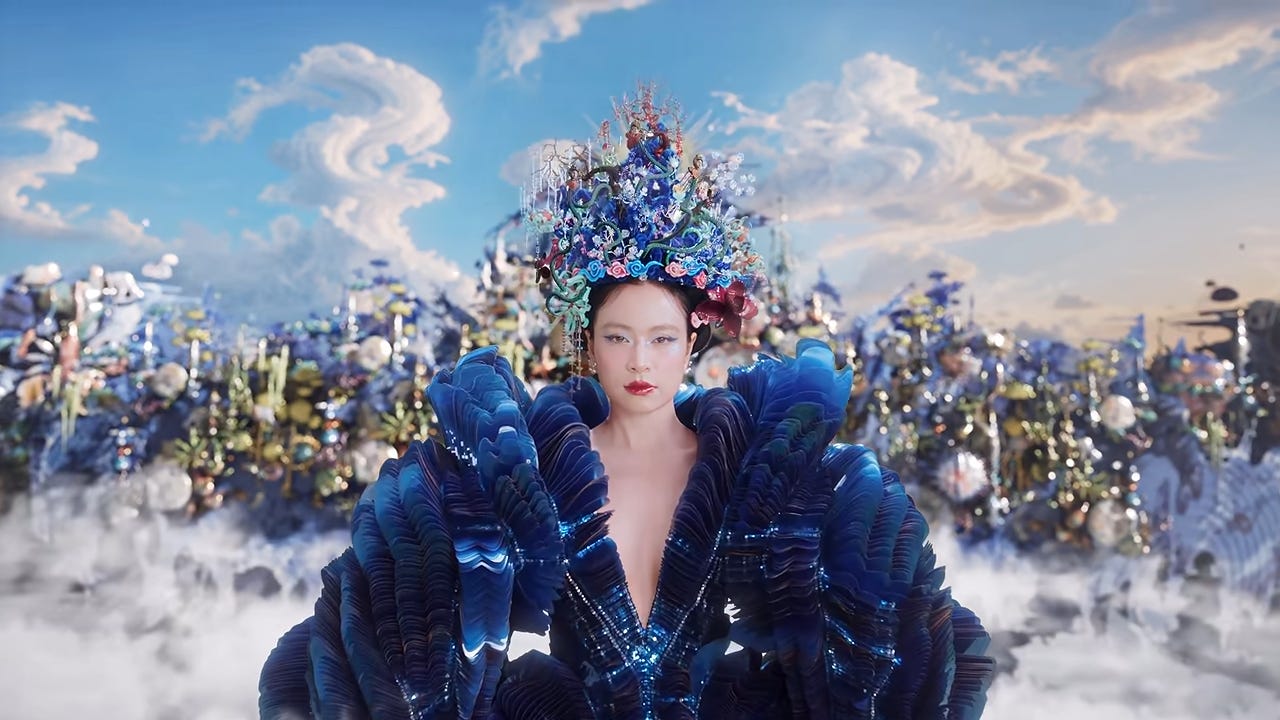
6. Hoàng Thùy Linh: Thầy Dùi
Vietnam
At this point lightly avant trap beats are nothing new in Vietnamese pop, but this song is restless enough to try out three or four other beats from around the world, too.
7. Slayla: Parjolo
Indonesia
Brazilian funk spotted in Indonesia! Weak as funk, but strong as generalist global pop.
8. RIRI2K: fomo :/
Italy
I thought this would be a Mexican reggaeton suite, but I still can’t tell the difference between Italian and Spanish from sound alone, so missed that this is another entry in the Italian reggaeton craze.
9. Denna La Porri, Legorreta: Sueño
Mexico
Meanwhile the actual Mexican reggaeton sounds a bit plainer by comparison. This is a recommendation from the original source of my Karen y Los Remedios album recommendation last week.
10. DJ CORA: African Legwork
Nigeria
Which regional styles get big regionally and then go global obviously has an element of randomness to it—I have no idea why cruise music never took off beyond Nigeria as Afrobeats started to wane globally, but I still enjoy it when it crosses my radar.
11. MfanaTouchLine, Blxckie f. Mellow & Sleazy: House Party Chronicles
South Africa
12. Matute Boy, Nimza The Bull f. Scotts Maphuma, Bob Mabena, Mdeshkayro, Lacto de Djy & King Deep: Rae Ira Nthwe
South Africa
13. Argento Dust, BOKKIEULT, Yandisa Ntusi: Phumelela
South Africa
Another South African suite, and a reminder that I could easily fill a full 20-track mix each week with South African house. (I am occasionally tempted to, if only as an excuse to do a less haphazard survey of the scenes.). Three that caught my attention: Mellow & Sleazy feature on what does in fact sound like party music from MfanaTouchLine and Blxckie; an easy bounce and swing from previously featured Matute Boy, and dreamy crescendopiano from new-to-me Argento Dust.
14. noa: 呼びすて [Yobisute]
Japan
Noa’s workmanlike J-pop career has a lot of highlights, even though she hasn’t made a fraction of the personality mark of anagram J-pop superstar Ano.
15. Harlem Yu: 枝仔冰 [Ice Pop]
Taiwan
A new single from longtime Taiwanese television personality and pop star Harlem Yu, who kicks off a series of songs starring or featuring children.
16. JUBJIB: ขอเกรดสี่ [“I Want an ‘A’”]
Thailand
This does not qualify as kid-pop, but it is by an influencer singing about getting a perfect grade (a “4,” which I’ve translated above into an “A”).
17. ABIGAiL: กุ๊กกู๋ [Kukku]
Thailand
Abigail was a Jel Bugle recommendation, rocks harder than you’d expect from a four-year-old, but does not rock as hard as Maya Bond did in 2005, or really more than any given four-year-old can rock just making horrible noise. Oh dear, Maya Bond is older than Olivia Rodrigo? Where does the time go.
18. Lalynn: Nemo
Thailand
What were the odds of finding two Thai kid-pop songs in the same week? Were these odds higher or lower than one of the songs featuring a Jersey club beat?
19. MI MI MARII: На ваші маски [Na Vashi Masky]
Ukraine
A lot of good, dark Ukrainian electropop this year. I’m planning to do something like a dilettante’s regional scene report for the year-ends and Ukraine is a country where I have a lot of music I like that doesn’t obviously add up to any insights beyond “there’s a lot of good music in Ukraine right now.” But there is!
20. Kacey Musgraves: Mi Tesoro
US
I enjoyed Kacey Musgraves’s duet with Carin León last year on “Lost in Translation,” which they recorded after both warming up for a gig with a popular Mexican song that Musgraves knew by heart. Her new album of Mexican-inspired material, including a few originals and a few covers like this one, are uniformly pretty and make me want to relisten to her album from earlier in the year. And a late post-script to add that I’m glad to have Texas represented this week! I wrote most of this newsletter before the midterm results.
21. Hitohira: Chase
Japan
Pretty Japanese indie rock transition to the final two songs about death and dead ends, respectively. Reminds me a bit of Dismemberment Plan on Change.
22. Weird 1000: Death
US
A recommendation from Kel, who tipped me off to Judith Horn’s “Deep Shit Times” in 2024, still one of my favorite songs of the decade. Kel has an ear for wry and righteous downers: this one takes on death in an irreverent way, addressing it as an old friend with an air of petulant annoyance, which felt pretty true to me.
23. Zoh Amba: Dead End Street
US
Finally, another one from my album recommendations this week from EA, bread and butter indie rocker whose voice reminds me of Angela Autumn’s strangulated yodel.
That’s it! Until next time, let me know what else is going on in Kenya.
—Dave Moore (the other one)
Title from Weird 1000: Death
At some level my theoretical interest in this is in how US English-language pop has not figured out how to ride various global waves, but that’s mostly by nature of my own perspective and background and comfort talking about things I already know a lot about. I don’t really enjoy listening to most of the English-language US stuff I have opinions about; I just don’t really know or understand the history of lots of global styles I’m drawn to and am mostly reactive to the good stuff I’m hearing. That is, I don’t have strong takes about what makes lots of global music go; I have much stronger takes about what makes US music stop.
The first hit I get on my blog for Afro house is: “Afro house proper doesn’t tend to grab me like the songs in the wider umbrella of South African house styles do; it’s maybe a little too clubby and international”