

It is time to go back to my childhood—the People’s Pop polls are tackling 1996, an important year in my own music listening because it was the first year that I felt genuinely plugged in to pop culture. 1996 was the year I clicked with Alanis Morissette, whose 1995 album disqualifies her from the poll, but also with Bone Thugs-n-Harmony and Blackstreet and Busta Rhymes and Rage Against the Machine and the Fugees and Sublime and “C’mon N’Ride It (The Train)” and “Return of the Mack” and “My Boo” and “Pony.” (It was not, however, the year that the Spice Girls conquered my middle school—I didn’t hear them until 1997.)
What has interested me most in the tournament so far, though, is that it has revealed some notable gaps between US and UK experiences of “songs of the year.” Many UK voters have commented that they never heard “One Headlight” by the Wallflowers or “My Boo” by Ghost Town DJs, and that the highest charting “Tha Crossroads” in the UK is not Bone Thugs (UK peak #8) but Blazin’ Crew (UK peak #1). Meanwhile, I had never even heard of Olive (the song itself doesn’t ring a bell either, was just outside the Top 40 in the US), who beat Bone Thugs in a headline match.
This got me wondering a bit about historical US/UK chart divergence. Andrew Hickey commented in this conversation that “1996 was probably the peak of the mid/late-nineties UK/US divide, which was as stark as the early-seventies or pre-1964 ones.” Centuries of Sound expanded the thought: “1996 we were starting to get some US rap & hip-hop again, after those couple of years where it was just the Outhere Brothers, but grunge and post-grunge was absent until the start of the 2000s.”
I noticed the pre-1964 chart divergence when I did some listening for a 1962 playlist—the Beatles really do seem like a meteor from outer space, albeit one that had received transmissions from the Everly Brothers’ “Cathy’s Clown,” #1 for seven weeks in the UK in 1960.
I’m aware of lots of songs that didn’t cross the pond in one direction or the other through many years of participation in Tom’s polls going back 20 years this year; in fact I think the last time we polled 1996 was in 2006 (me in 2006 re: 1996: “it’s the year where I knew EVERYTHING on this chart, and have very specific recollections of the music in the actual context of my life at the time”). But I wondered if there was a quick way to compare UK/US divergence. The simplest one I could think of was to use simultaneous shared #1s as a proxy. That is to say, songs that were #1 in the US and UK during the same weeks.1
This gives you the following list:
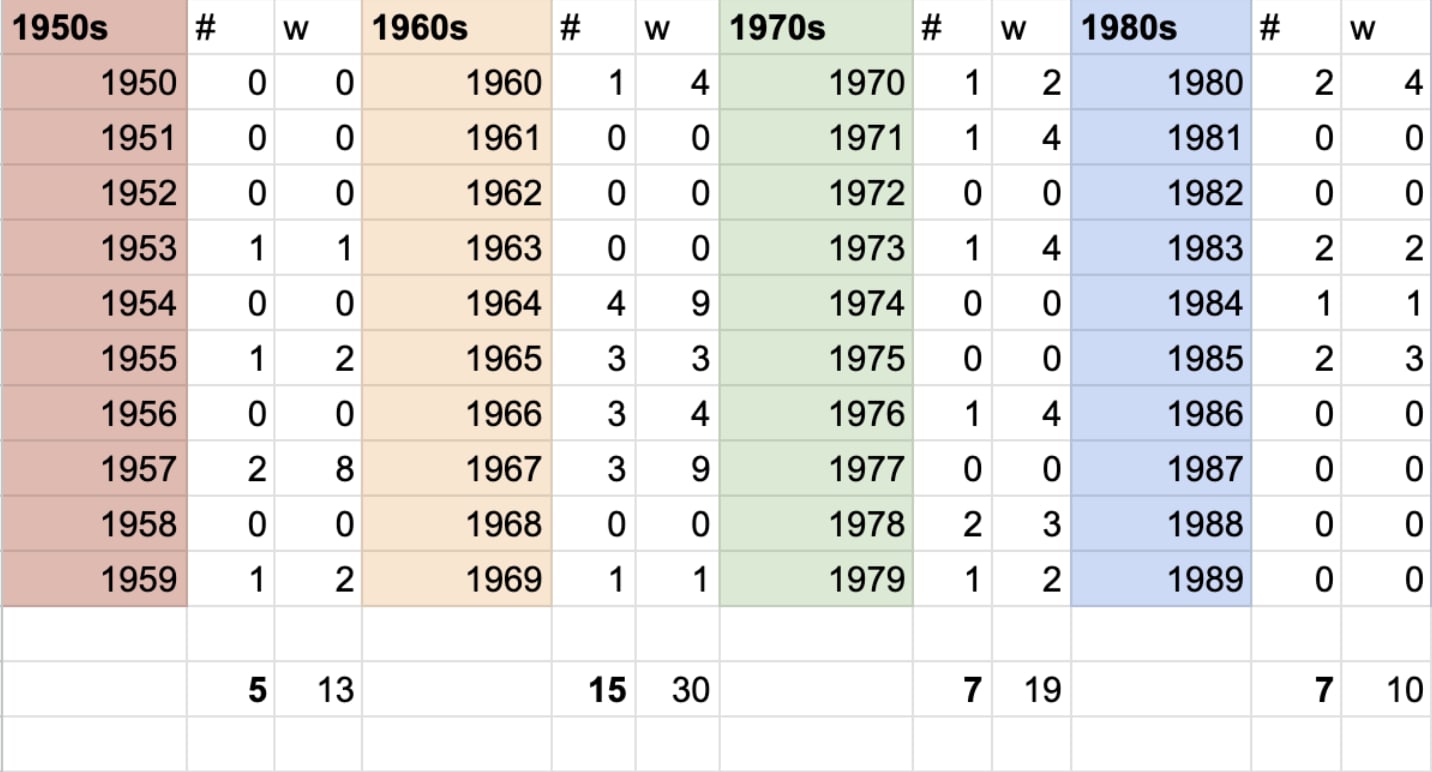
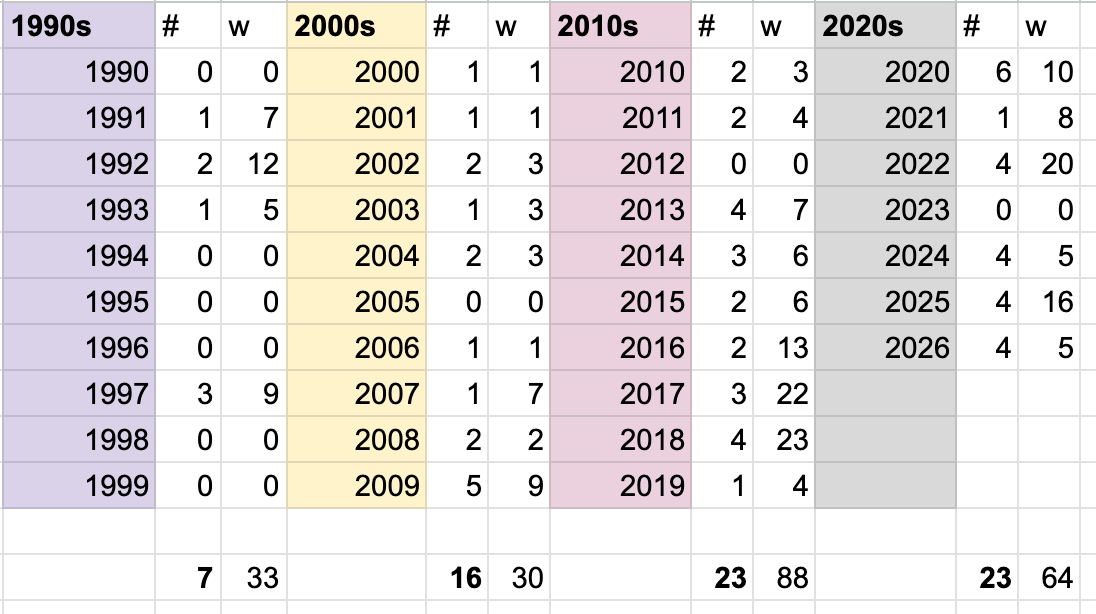
That’s every year for each decade from 1950-2026. I recorded the number of songs that shared a #1 simultaneously in the US and the UK (in the “#” column) and also the number of weeks collectively that those songs were #1 on both charts at the same time (the “w” column).2
The mid-90s are indeed a bit of a dead zone, with no overlapping #1s between 1994-1996. The high total number of shared weeks for #1s in the US and UK in the 1990s is inflated a bit by Whitney Houston’s “I Will Always Love You,” which was #1 in both countries simultaneously for a then-record 10 weeks, a feat that would only be repeated or broken (so far) by Ed Sheeran’s “Shape of You” (11 weeks) and Luis Fonsi’s “Despacito” (10 weeks) in 2017.
The #1s convergence grows through the 2000s and explodes in the 2010s—most of this can probably be attributed to streaming, where release dates are more coordinated globally and first-week global sales make a big difference. Sometimes songs will hang on for several weeks after a huge week 1, but other times will just hit big at #1 before dropping off the global charts.
We may be looking at a “new normal” of this kind of chart convergence in the #1 spot—I don’t see how you get around the ruthless global streaming launches of existing megacelebrities. I wonder if there’s any way for US and UK charts meaningfully diverge again.
I’d be interested to explore this a bit more beyond the #1 overlap stat and see if the historical “dead zones” on this list correspond to greater divergence in songs on the charts. But in the meantime, if you happen to meet (or to be) a British person interested in the music of 1996, please know from someone who lived through it in the US that you can probably skip “One Headlight” if you haven’t heard it by now, but by all means drop everything and listen to “My Boo” as soon as possible. Olive was pretty good!
1. Chloé Caillet: Bad Bara
France
It’s mostly a Golden Beatology week this week, lots of party tunes for weather too hot to party in. Kicking things off with a Ninja Tune summer jam that reminded me a little of the DJ Yam Who rework of Parallel Dance Ensemble’s “Turtle Pizza Cadillac,” a chant-along staple in my household and a song I last mentioned here in my very first newsletter. At that time, I figured I would publish something whenever I got a CD-length mix together, which historically had been about once a month. I’ve now published one every single week for nearly four years.
2. Ubunto: O Vento Part, As Ganhadeiras de Itapuã [2022]
Brazil
A fantastic track on a strong Bongo Joe compilation that includes plenty of, you guessed it, bongos. (Bandcamp lists the album this is from as 2022, but most other info I found points to a physical release in 2024.)
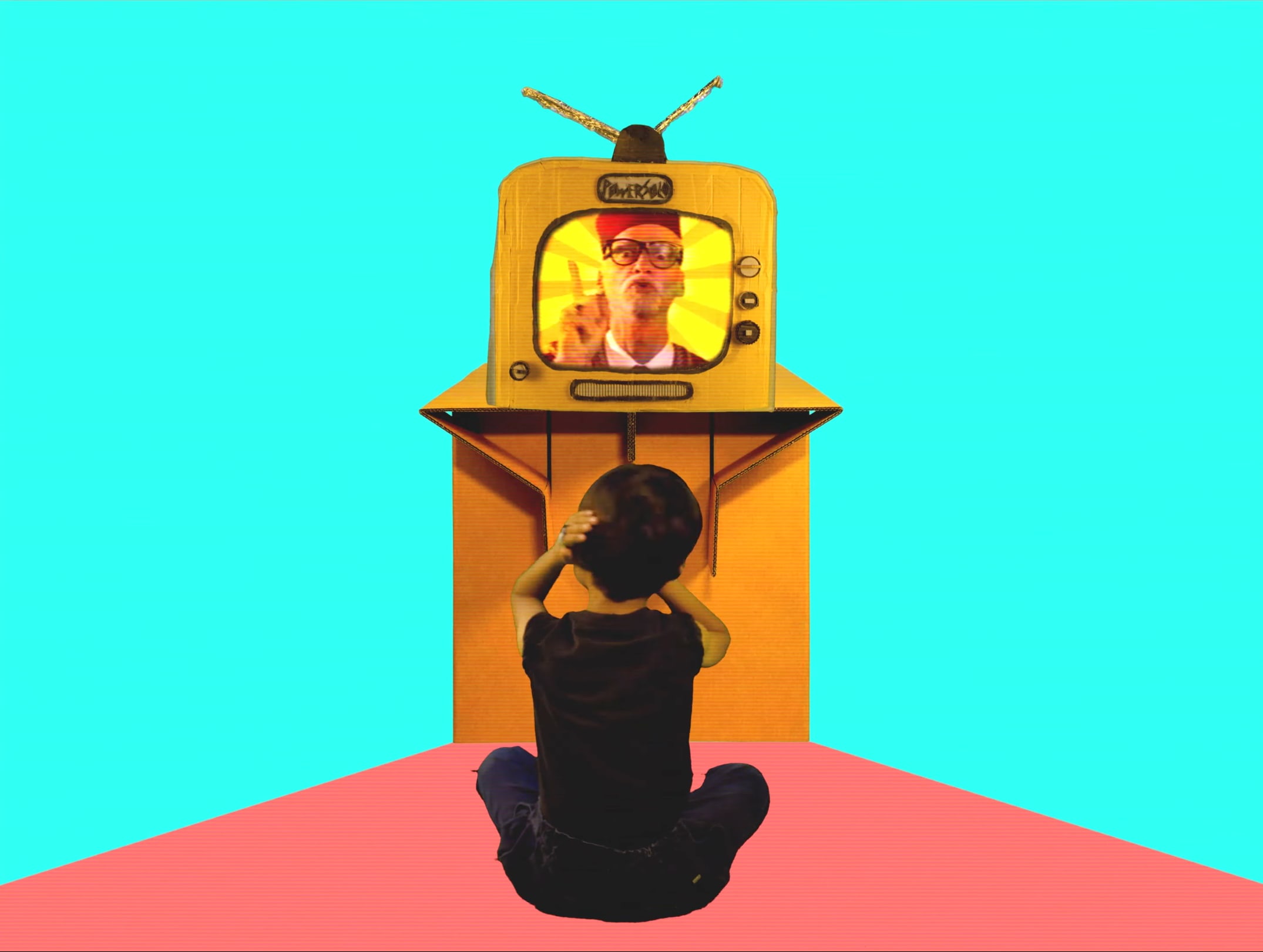
3. PowerSolo: Habibi Bob
Denmark
Was not surprised to learn that these new-to-me (I think?) but established Danish garage rockers have been longtime collaborators with Jon Spencer.
4. Gabriele Poso: 01 AM
Italy
Yeah, yeah, more bongos. What, you don’t want more bongos?
5. Acid Arab f. Cheba Ibtissem: Ktafi Bardine
Algeria-France, Tunisia
Haven’t yet checked out the new Acid Arab album, which at a glance doesn’t have as forceful a banger as “Döne Döne” from 2023, but it still grooves just fine with a bunch of MENA pop guests, like Tunisian singer Cheba Ibtissem on this track.
6. Vanita Leo, Sophie Castillo: Putiwepa
Mexico-US, Colombia-UK
Day-glo diasporic reggaeton-pop, with one artist based in the US and the other based in the UK.
7. Carla Clavijo, Cande Gonzalez, Omar Varela: Fala de Mais
Argentina
Argentine brega funk, would have guessed it was Brazilian before I clicked through. Don’t know anything about the crossover in Argentina, but should maybe look into it.
8. Lera Fatforest: Girls Vibe
Ukraine
One of the better Ukrainian dance tracks I’ve heard recently. I bet the spoken breakdown in the middle is funny, but I do not speak Ukrainian.
9. Maria Daniela Y Su Sonido Lasser: Hoja al Viento
Mexico
Have to keep up my Maria Daniela representation—haven’t featured her since 2023!
10. vgtbl.pl, Clementine le Fruit: Les légumes
Poland
Polish goofballs mix Polish and French to remind you to eat your veggies, likely with lots of wordplay and double entendres I’m missing.
11. Aspen Kartier f. K-Money: Bring It
US
No wordplay missed on this one, though, and the entendres are mostly single.
12. DJ ML ORIGINAL, Mc Gw, Mc Magrinho: Ela Fez 18 Anos
Brazil
Phonk remix of a song from 2013. One of my kids was interested in the clave rhythm and we talked about the finer points of phonk versus funk. (He doesn’t really like either, though.)
13. Sskyron, DjDanWayo: Hin Hin Hin [2025]
Réunion
A 2025 song got through my dancehall playlists this week, but it was too good to leave off.
14. Kaaris: Huracan
France
15. Dynaso Wegoso: Atasa
Uganda
Two macho poses that seem more playful than they let on, from a French rapper and a new playlist of Ugandan hip-hop I found this week, respectively.
16. Neyna: Lebam
Cape Verde
This is one from my favorite music thread of the year so far, Jonathan Bogart’s list of “some of the more interesting (not nec. complimentary) music i find over the course of the year,” which so far apparently means it aligns much more closely with my own taste than his.
Of this one, Bogart sez: “despite a solid decade of posting i don't believe i've ever successfully converted anyone else into caring about kizomba, the signature creamily romantic rhythm of Portuguese Africa, but that's fine, more for me.”
This is only true to the extent that every time I think I’ve found a kizomba artist I like it turns out not really to be kizomba, just an errant genre tag. So I hereby resolve to listen to more actual kizomba.
17. Asayel: Smo Alay
Saudi Arabia
Was so blown away with Asayel upon finding her single “Asliyah” for the World Cup of Pop that I have an alert on her for new releases. This is the most recent one, a brief but pleasant Afrobeats-ish number.
18. Sandra Kolstad: Fiat
Norway
No idea where this single-digit-view arty sequencer pop came from (aside from Norway), like The Knife if it happened to be a butter knife. I enjoyed it.
19. Yushh: Mos Def
UK
The sort of bloops and clacks and thoughtful head nodding stuff that now gets called “intricate” and used to get called IDM. She’s great, and based in Bristol.
20. Vĩ: Sóng Thần
Vietnam
The return of Vĩ, whose name changes and discography reshufflings have made her a bit hard to follow, not to mention functionally un-googleable (but then what is functionally googleable these days). This iteration seems to have stabilized and she’s collected most of her material here after some of it had disappeared for a while. The Bandcamp page does not include this week’s ambient closer, but it does include a separate experimental 9-minute track/EP(?) from April if you’re so inclined.
That’s it! Until next time, listen to “My Boo” again.
—Dave Moore (the other one)
Title from vgtbl.pl, Clementine le Fruit: Les légumes (“Je vis ma vis je suis vitaminée”)
This is admittedly not a strong way to compare charts. Songs might just reach number one in different weeks, and including the rest of the charts would tell you if there is more systematic overlap between the UK and US. But “number of songs that only appear on either the US or UK chart” requires far more spreadsheet firepower than I’m able to handle for a blog post.
I mostly used the Wikipedia entry for simultaneous #1s, but it has not been updated since early 2024. I did the best I could to fill the rest in. That includes adding:
In 2024, Hozier’s “Too Sweet,” Taylor Swift’s “Fortnight,” Sabrina Carpenter’s “Please Please Please” (all three overlapped for one week), to join “Texas Hold ‘Em” by Beyoncé, which was accounted for.
In 2025, 3 weeks for “Ordinary,” 6 weeks for KPDH’s “Golden,” 6 weeks for Taylor Swift’s “Fate of Ophelia,” and 1 week for Sabrina Carpenter’s “Manchild.”
In 2026 so far, 4 shared #1s: 2 weeks for Taylor Swift’s Toy Story song, 1 week for Harry Styles’s “Aperture,” 1 week for Olivia Rodrigo’s “Drop Dead,” and 1 week for Ariana Grande’s “Hate That I Made You Love Me.”
"number of weeks collectively that those songs were on both charts at the same time"
Just to make sure I've got the second number right: first number is number of songs that overlapped at number one. But is the second number the number of weeks such songs overlapped at number one, or is it the number of weeks the relevant songs overlapped on the charts (i.e., for the songs that hit number one simultaneously, this totals the number of weeks song A is on both *charts* somewhere between 1 and 40 at the same time, song B is on both charts between 1 and 40 at the same time, etc.)? Your *words* seem to be saying the second, though I was originally assuming you meant the first.