

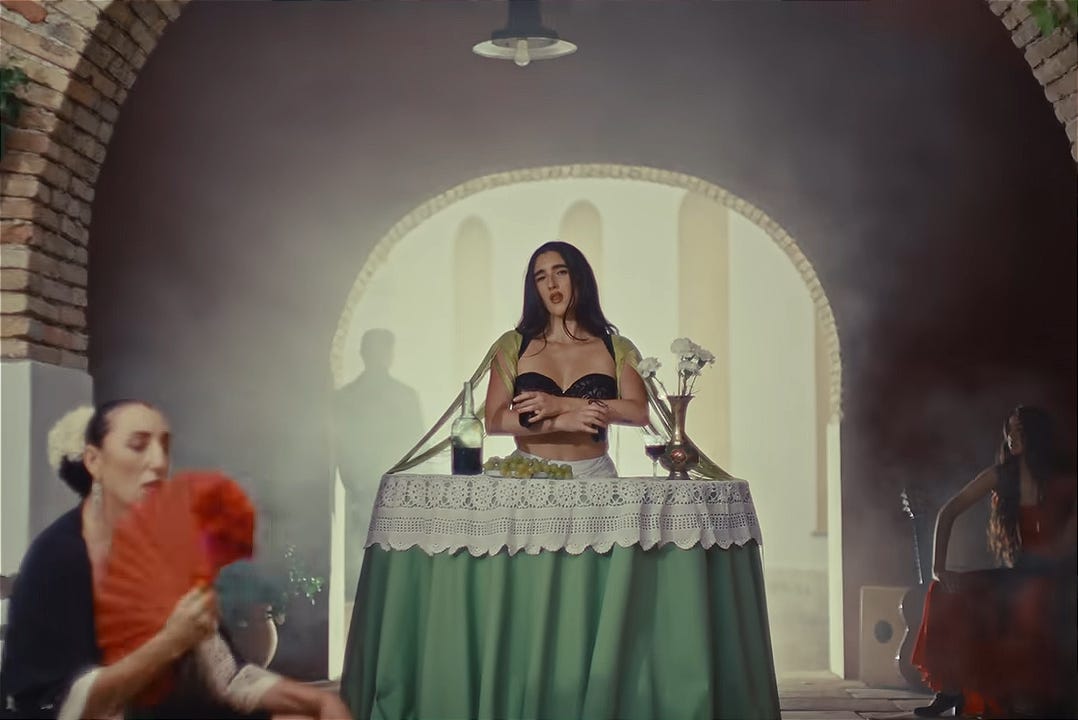
This week I went through the year in the Billboard Global 200 Excluding US (GXU) and tried to see what the chart would look like as a generally non-Anglosphere measure of global popularity, by saving every song that debuted between December 2025 and now that I would not file in my US or Anglosphere regional categories. The process yielded about 200 songs, with 130 tracks by unique artists. Beyond specific problems with recurrent tracks, the GXU generally has the same problem as the Anglosphere’s charts—huge music celebrities will debut with their entire album on the chart. This happened on the GXU with K-pop groups BTS, BLACKPINK, and PLAVE, along with Mexican star Peso Pluma.
Here is a playlist of all of the songs I pulled. Accounting only for tracks by unique artists, you get a picture of global representation that looks like this:
30% K-pop;
20% other Asian pop, which includes a mix of J-pop, Bollywood, and a few tracks from the Philippines and Indonesia;
20% Latin American pop, with most of this divided between Mexico, Puerto Rico, and Brazil, with some representation from Colombia;
25% European pop or cross-country collaborations with European DJs or Anglosphere artists;
and 5% Africa and MENAT, mostly from Nigeria (especially Asake) and Turkey (especially Turkish girl group Manifest).
I’ve already featured on my mixes a few of the tracks from the GXU list over the course of the year. Ditonellapiaga’s runner-up Italian qualifier for Eurovision “Che fastidio!” appeared on the chart. There are a few K-pop tracks that I shared, like KiiiKiii’s “404 (New Era).” There are also a few songs I shared specifically because they did well globally, like Karol G’s “Bby Wow” and Vacra f. La Refleuze’s “Fille à Papa.” I apparently already shared a popular Nigerian track, Wizkid f. Asake’s “Jogodo,” which I only (re)learned when I set it aside for next week’s final mix and saw it was a duplicate.
Skimming through songs on the GXU chart didn’t do much better than using a more random selection of new songs in terms of piquing my interest—I singled out only four songs to consider for my final mix of the year next week (at press time only two have actually made it on the mix, which is the usual ~1% of what I listen to each week). Global popularity neither unearthed new styles nor introduced to me to major work that I felt like I’d missed. In fact, I have a sense that I’ve probably briefly heard and quickly skipped most of this stuff before, possibly several times, over the course of the year.
But I still think the biggest problem with the GXU is in how this chart is conceived: in a whole year’s worth of non-Anglosphere tracks, you could barely fill all of the slots in one weekly instance of the Billboard 200 chart. There are about three to five new global songs debuting each week, unless there’s a major album release and all of its songs wind up on the chart. In many weeks no new global songs debuted at all.
But imagine if instead of 200 tracks across 12 months, you could instead get the same number of tracks across as many weeks, just by changing recurrence rules and decluttering the half of the chart dedicated to random old songs. You’d get a much better sampling of regional heatseekers, even if these charts still suffer from the same incumbency and stagnancy problems of all other contemporary charts.
So I’ll keep an eye on this chart, but after all that effort, I don’t feel compelled to track it that closely without significant changes to how the chart is calculated.
As for where you’ll find more actionable information about global music, part of it is just plowing your way through the wilds of enthusiast criticism (as usual), which is how I came across +SIX12, a Melbourne venue specializing in mapping Asia-Pacific electronic music (h/t Boombop Indica). They have a primer up on both Vietnamese and Indonesian labels, with tons of great information. My own beat, such as it is, sometimes intersects with these scenes, but for the most part I tend toward more generalist mainstream pop.
In keeping with that vague remit, I’m trying to write something like a dilettante’s guide to global pop as a part of my year-end features. This is meant as a shallow and impressionistic sense of what’s going on around the world, especially for people who skim these newsletters without necessarily being super interested in (or able to keep up with) all of the music I’m sharing. I’ll also do my usual Best Words feature, songs of the year, regional stats, and maybe something on albums, though most of my album-writing I’ve relegated to monthly recaps.
The last one of those monthly recaps will be next week, and then it’s no new music until the new year. See you on the other side!
1. Judeline: La Falda
Spain
This week I did some due diligence around songs I’ve longlisted for mixes in my “Latin America/Spanish language” holdover list, as well as using that list to find some YouTube playlists compiling the year’s Spanish-language music. YouTube led me to this Spanish reggaeton number that I was surprised to blush at when I hit “translate.” But it did provide the newsletter title this week—and she’s not kidding around with that title, either.
2. Arlene MC, Alofoke Music, Jey One, La Mas Doll: Saca Punta
Dominican Republic-US/Dominican Republic
3. Angel Dior, Anthony Singer, Elmaestrox9: Si la Cojo
Dominican Republic
I’ve given short shrift to dembow this year, even though a lot of dembow has made its way into other global music, and the scene itself has continued to get poppier, moving away from too-long runtimes that made its effervescence quickly become a chore in previous years. I’m sure a more concerted search would yield more songs, but for now I seem to have landed on a few artists who were already favorites, Arlene MC and Angel Dior.
4. Angel Almaguer, FLVCKKA, angely2k
Mexico
Mexican incorporation of Brazilian funk in its pop scene has been funky in the “something smells weird in the fridge” sense; on this one they slam clave from cowbell clatter against the whistle sample from Twisted Nerve used in Kill Bill.
5. La Perversa, Hansel Acocotealo: No Me Llames
Dominican Republic
Back to dembow with another favorite, and a reminder that dembow is maybe going through some version of what US rap—and other global rap scenes, including other parts of Latin America, France, and Germany—is going through: a gradual eclipsing of the mainstay men of the genre by women who have the same technical skill (or greater) but can also get a party started more reliably and unashamedly. I think there’s a parallel to made here with rock music, too, but I’ll save it for year-end musings.
6. Marla Kether, Mez: Blessing
DRC-UK/UK
It’s been a while since I formally acknowledged something as Golden Beatology of the week, but this is the sort of thing I could imagine doing well as a discovery in year-end polls, from a British artist/DJ/bassist of Congolese heritage who does global African and Latin styles with vocals more indebted to a mix of grime and dancehall.
7. NEGRO DUB, Zé Pequeña: Juana la Cubana
Argentina
Some Argentine cumbia turra from another of my Latin American holdovers, though it features surprisingly little keytar given how prominent the keytar is in the video.
8. Merveille: Illico Presto
DRC-France
On to what is now I guess an obligatory Francophone post(?)-dancehall block, starting with Merveille, who beguiled on her EP from this year but here leans into Brazilian hard clave set perpendicular to pretty harp arpeggios and the unassuming wash of her vocals.
9. Sarahmée: Hiver
Senegal-Canada
Yes, it’s more off-the-radar (still triple digit Youtube views) bouyon pop from Montreal, really can’t get enough of this stuff. I will put together a long Francophone mix as part of the year-ends.
10. Ks Bloom: Jerusalem
Côte d’Ivoire
Ivorian pop is kind of a confounding variable in determining a Great Bouyon Speed Up in African Francophone pop because its dancefloor polyrhythms are already plenty fast, but this song in particular does sound like it’s been augmented—tempered?—with a bouyon beat.
11. MEEA, Lucky lukee: Sé Vikini
Guadeloupe
Last week I said I would look into more Dominica bouyon, but alas, Guadeloupe bouyon keeps insisting its way onto my mixes. Oh well!
12. Samthing Soweto, Entity MusiQ, Alie-Keys: Hey Wena [2020]
South Africa
13. Masterpiece YVK, J’Something, Ceeka RSA: Mi Amor
South Africa
From Francophone pop to South African house, starting with one of the most solid grooves I’ve heard out of amapiano this year, from Samthing Soweto (NB: “solid groove” is not exactly what I’m looking for in my amapiano, so this is not as big of an achievement as it might appear, but it is the sort of amapiano I’d be more likely to nominate in year-end polls). [ETA: I have been informed that I missed the release date on that great Samthing Soweto track! It’s a 2020 track getting a TikTok push!] Then flamenco guitar and vocals in Spanish from Masterpiece YVK.
14. ORCH f. King Ketelby James: Fete
Nigeria/Ghana
Interesting blend of soukous and Afrobeats from a collaboration between a Nigerian and Ghanaian producer.
15. Vanita Leo: Vatos
Mexico-US
Have featured Vanita Leo at least once this year, but her album is great and I’ll mention it in my final monthly round-up next week. Had a few of her songs kicking around in my holdover list.
16. Yapi: Guantánamo
Spain
This is another YouTube find along with opener Judeline this week, from a playlist that I have lost track of that featured a lot of rising Spanish artists alongside the usual suspects popular on the GXU. Was drawn to this Afrobeats-influenced single.
17. Wegz: El Hazz
Egypt
My attempt to find more MENA pop this year has been less successful. Have featured Wegz before and enjoyed the way this one suggested a midway point between the distinctive two-count feels of reggaeton and Egyptian pop.
I try to keep up with Saeed Saeed’s writing on Middle Eastern pop, and back in June he described a story of simultaneous regionalization and globalization that I’ve been circling around this year in several posts. He mentioned Wegz in a piece on Middle Eastern pop trends:
Another defining takeaway from 2025 is the growing importance of local identity as a driver of global success, a trend Abou Jaoude expects to intensify in the coming year.
“Arabic music as a whole is getting more attention globally as well as locally,” he says. “There was a time when artists thought they needed to sound international, but that is no longer the case and this will continue to happen for a while yet.”
And:
Building an international audience no longer requires sacrificing language or dialect. While diaspora audiences remain important, Abou Jaoude says Arabic music is increasingly reaching listeners with no cultural or linguistic connection to the region.
“Look at Wegz’s growth from Alexandria in Egypt to sold-out shows across Europe,” he says. “Then you have Saudi singer Ayed, who has major audiences as far as Indonesia.
“Music is more accessible than ever,” he adds. “That opens up huge potential. But how that potential is realised depends on how music is produced, marketed and supported.”
18. Mae: Messy Comme Lola
Switzerland
She might be messy like Lola Young, but she’s tuneful like other attempts at A-pop sounds (expand the “A” to Anglophone as need be) in other languages, the sort of effortless banger I just don’t get as frequently from the alt-confessional types these days. I think it has something to do with routes for attitude and disaffection—in French you can go blank without having to tap in to tired post-punk sprechgesang or affected marshmallow mouth or annoying enunciation like you’re doing the Glee version of a Courtney Love song.
19. KOÑ: Nie pójdę na L4
Poland
Speaking of tired post-punk, here’s some Polish skronk to jostle it awake for you.
20. Karen Kong: 死神來了 [Sǐshén láile / Final Destination]
Malaysia-China
Billie Eilish(…ish) electro that’s not afraid to sing out.
21. ASLY: Yangin
Turkey
A charming single from a rising Turkish star who sounds like Icona Pop without the budget to drive a car off a bridge; she settles for a wheelie office chair instead.
22. Cwondo: Pecha Kucha
Japan
Plinky plunky post-script cutup from a Japanese producer who is a bigger deal as a songwriter in Japan than I expected, according to the folks I trust on Japanese pop.
That’s it! Until next time, don’t hold back all those good songs you’ve been hoarding for months.
—Dave Moore (the other one)
Title from Judeline: La Falda (“Se pone asqueroso”)