

If you spend enough of your time online with British music nerds, you start to engage with questions like “is there a US equivalent to the Manic Street Preachers?” That is: a band big in the home country with basically no crossover to a usually sympathetic market. This was the question du jour a week or so ago as one of the Manics’ biggest UK hits, “A Design for Life,” appeared in the People’s Pop Poll of 1996.
My first impulse was to compare the Manics to Tragically Hip, the Canadian band that seems to have about a hundred songs that all Canadians know by heart and I’ve never heard before. (I was glad that someone else brought up the comparison first; Canadians in the thread grumbled but a few of them reluctantly agreed.) The band I’m imagining not only stays within its home country, but in some way typifies some perceived essential [home country]ness, and doing it in a way that sparks not only local chart success, but also a meaningful debate about a whole body of work amongst its home audience that is incomprehensible abroad.
I don’t think I could hum you a single Manic Street Preachers or Tragically Hip song at all, though I could maybe name one or two from observing other people from other places talking about them. I miss not only the appeal of these groups, but the basic entry-level context in which you would even distinguish between their songs. (To both bands credit, I have never actually tried to do this, have always been turned off for shallower reasons of thinking the bands sound kind of boring.)
Andrew Unterberger suggests that it wouldn’t be possible for any US rock group of the Manics’ era to have a career like that: “May largely be a matter of chart differences between the two countries but I am very confident a reverse Manics—a U.S. rock band with multiple massive hits + major cultural presence stretched across multiple albums but zero U.K. chart impact —simply does not exist. Not in the ‘90s anyway.”
Interestingly, the thing that sparked these musings was the pairing of the Manic Street Preachers with Sublime in the People’s Pop 1996 poll, where Sublime got walloped by the Manics (and also by the winner of that round, “Return of the Mack” by Mark Morrison). UK voters responded to “What I’ve Got” with the same bemused confusion that many US voters did to Manic Street Preachers. Tom Ewing compared Sublime to Beck, which, when I ignored my entire childhood and adolescent listening history, I could sort of hear, even though socially it makes no real sense to me (my high school band covered at least three Sublime songs but no Beck).
Sublime fits the chart picture, too: an all-time UK chart peak of #71 with “What I’ve Got” with only one other entry listed, and it’s an error: the second charting Sublime song is 2003 house track “Sublime” by Keep the Change, which is listed with its title and artist switched on Official Charts.
The mention of Sublime in the conversation opened up references to other bands from the mid-90s, many of them jammy, ambiguously ironic, or slacker-adjacent, like Cake (two short-lived Top 40s in the UK in 1997) or Dave Matthews Band (barely cracked the Top 40 for “The Space Between”).
Jonathan Bogart made a connection to carnival barking as a US analogue to a music hall tradition. This in turn put me in mind of one of the few books I managed to get through in the past year, and which I immediately called the Great American Novel in a Boss Baby Tweet sort of way. That book was Nightmare Alley, William Lindsay Gresham’s jaundiced and funny noir about carnival hucksters, mysticism, alcoholism, and conning the rich with woo-woo. (Gresham is smart and/or caustic enough to rope psychoanalysis in with the rest of the snake oil.) I agree with the friend who recommended it that it may not the best American novel, but it might be the novel that contains the most America per square inch. It’s pretty lean, but it still makes room for a major plot point that hinges on enrolling a filthy bodega cat in a scheme to swindle an automobile tycoon.
I’ve always been drawn aesthetically to some of the more benign forms of American hucksterism—more infomercial than prosperity gospel—and have managed not to parlay this into inflicting or falling prey to a variety of scams or vices. I think there’s something to the music hall comparison: music hall generally sets my teeth on edge, but carnival barking gets you to corners of my taste like Mike Patton and Mr. Bungle, Primus, Ween, and any number of sellout singles from alt bands—like Butthole Surfers’ “Pepper,” which didn’t make it to the 1996 People’s Pop finals.
It’s always worth thinking a bit more about country music crossover (or lack thereof) between the US and UK, too. There’s plenty of divergence there—Garth Brooks barely made a dent on the UK singles charts, say. But some contemporary country in the current US Top 40 wave has done much better in the UK than other parts of the world.
This is all to say that I’m interested in tracking regional US music in a post-A-pop sort of way, thinking about how the US has always had distinctively regional pathways for music that haven’t translated. Maybe this is will provide of glimpse of where US music will itself go—or perhaps recede—into local niches that largely stay put.
1. The Vampire Lestat: Long Face
Australia
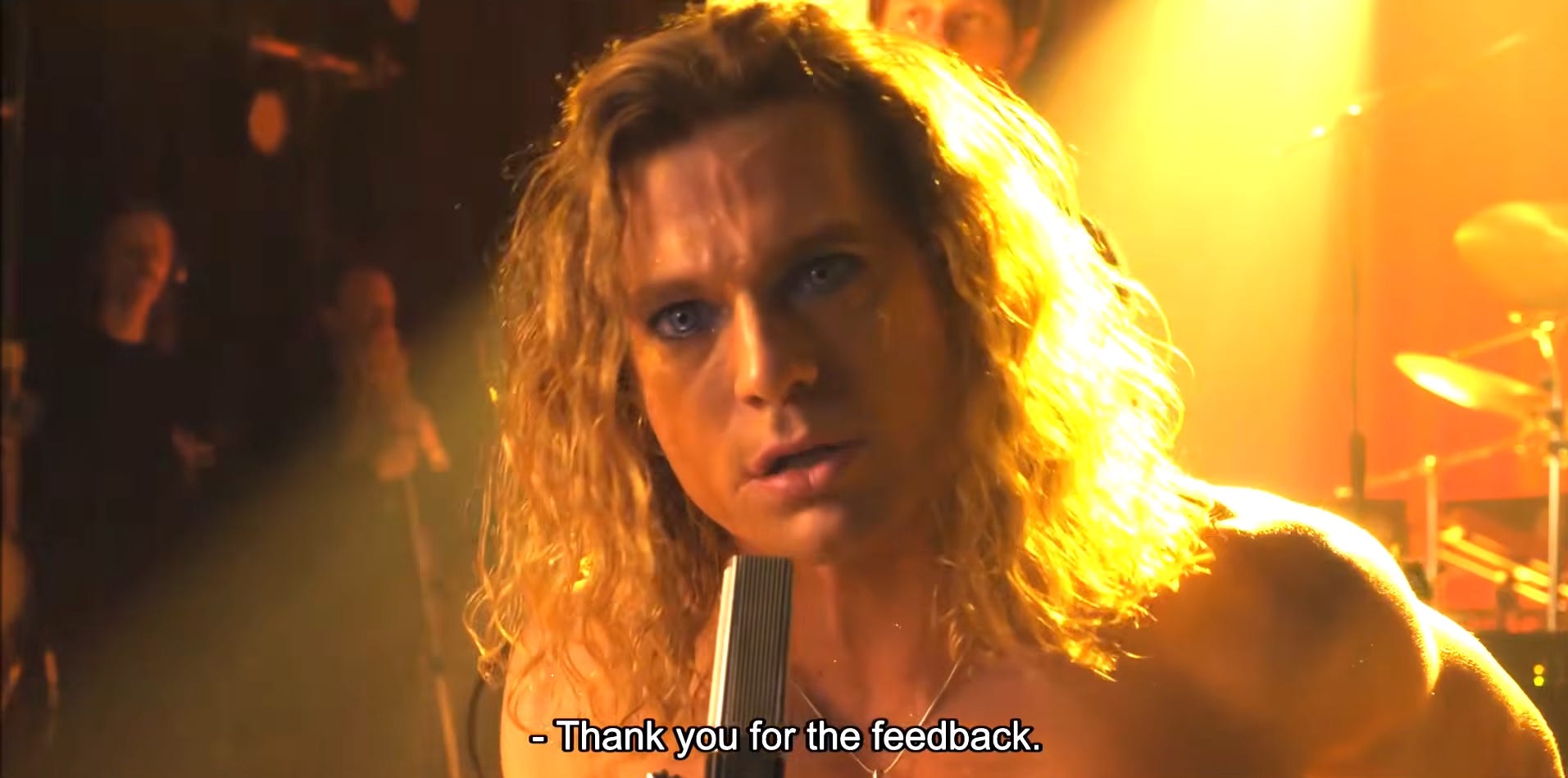
I have been told by at least one reputable source (the same one who recommended Nightmare Alley! Thx Isabel!) that I should really be watching the sexy vampire show. I think that actually being taken in by an in-universe song from Sam Reid, who plays Lestat, should push it further to the top of my queue. (It’s a short queue and I’ve already seen Widow’s Bay.) I don’t know how the libidinality—libidosity? libinitudinousness?—is supposed to play on the show musicwise (at least one character telepathically heckles Lestat and tells him this song sucks). But the mix of sexy and goofy gets it close enough to John Cameron Mitchell, which itself was close enough to glam. Glampires! Surely someone has coined this already?
2. GAYLE: Junebug!
US
A few years ago I set off a minor discourse bomb on early Bluesky claiming that GAYLE was merely a standard deviation away from the post-teenpop alt-confessional haves (Olivia Rodrigo, mostly). Any attempt to do post-pop impressionism from Kara DioGuardi (as mentor not writer) was going to get my attention, and it did, though “abcdefu,” GAYLE’s biggest hit, wasn’t really something I cared much about. But she’s come into her own as a too-many-syllables-not-enough-tunes semi-star, and I still think she sounds better than plenty of other syllable-slingers. She doesn’t sound like an actor pretending to be a pop star (no offense to The Vampire Lestat).
Editorial note: I guess this is as good a place as any to let you all know that the hierarchy of power in the CAPDY universe has changed! The “P” no longer stands for Kim Petras, who did not get the critical traction I thought she might, but rather for (duh) Phoebe Bridgers. My personal rankings do not really change, though: Charli > Ariana > Phoebe > slaYYYter > Disney.
3. piri: Both Be Happier
UK
Post-pop impressionism isn’t rocket surgery — piri shows that all you have to do is stick some lite dnb-pop in the background and you can easily rise above the labored sneers of the average post-popper, even without much tune to speak of.
4. Samara Cyn f. Ovrkast.: Bushwick
US
Have probably been underrating Samara Cyn since I inexplicably compared one of her older singles to “iPod commercial music,” which even for someone who compares a lot of music to iPod commercials in a non-derogatory way was probably a stretch.
5. Luci Gang: Easy A
South Korea
Via Kogan/Henderson, have been checking out K-rapper Luci Gang, who happened to show up in my playlists this week with a new release after being shared by a few social media mutuals for a different single that seems to be getting more heat than this one (“Headlock”). Can’t remember why I picked this one instead; both are good.
6. Allnight: Bang Bang Bang (Radio Edit)
US
Miami DJ keeps a stealth electroclash revival going in a way that doesn’t draw too much attention to itself, and maybe doesn’t draw enough attention to itself.
7. Son Rompe Pera: Reptilio
Mexico
Psych-cumbia that earned a fist pump from me at some point while listening to it.
8. Shannon: Tête
Martinique
More evidence of light-speed ferment in bouyon among various Francophone scenes, with more to come next week. This one’s from a shatta star and mix mainstay (with I think a song every year since 2023), who has combined shatta and bouyon across a solid new album I’ll probably write up in the end of month recap.
9. Bamby, Rambo Goyard: Gogowine
Guyana-France/DRC-France
Another dancehall star riding bouyon rhythm, though the timing is not as fortuitous: her full-length from 2025 (Muse, which I probably underrated) feels light years away already.
10. Paulo Chakal: Antou (Nan Guin Nan Wan)
Côte D’Ivoire
Have recommitted myself to finding a few new sources for coupé decalé and biama music after reading a recent article about the latter in the Guardian. I’ll admit that I have a hard time distinguishing between biama and coupé decalé since, as I understand it, the biama trend has sped up tempos across subgenres and there aren’t hard lines between them. (A lot of songs that I see categorized as biama I’ve covered previously using interchangeable terms.) No such confusion here, though—rap Ivoire/R&B with a breezy tempo and production more indebted to pan-regional afropiano.1
11. Zarhzä, DJ Tagada: Les Oiseaux de Tapage - Remix
France
Hard-to-categorize but easy-to-move-to Balkan-Latin-French global dance-pop melange.
12. Pedro Sampaio, Cachirula, Loojan: Tímida, Santa y Peligrosa
Brazil/Mexico
Fun Brazilian/Mexican reggaeton tag team.
13. Baba Harare: Tsa Tsa Tsa
Zimbabwe
Logdrums programmed into tricky polyrhythms like they’re trying to reinforce the song with an exoskeleton coated in a comic book super-polymer.
14. Cheyada: พันธนาการ [Phạnṭhnākār]
Thailand
Chayada has appeared twice on my mixes before, and I’ve referred to her as going soft indie rock without turning to mush (high praise) and “decaffeinated but not entirely free of caffeine” (not high praise, but not a slam since I switched to decaf myself). She upped the formula to half-caf.
15. Sangay Lhaden: Pemi Tshewang Tashi - The Legend
Bhutan
Bhutan is the second country after Laos that has never appeared on a mix. Cheating a bit with this one by reviewing the Bhutanese finalists for the new Eurovision Asian contest (they got second place in the qualifier). Could cross two more off my country list this way with Nepal and Mongolia to represent everyone competing—will at least try to find something from those countries before the end of the year.
16. Meshell Ndegeocello f. Cat Power: Don’t You Want Me
US
Another week, another smoky cover of a pop classic. I’d give the edge to Kurena Ishikawa’s “Les Fleurs” last week but this one’s pretty good, and might be the last appearance of Cat Power on a mix for a while if she really has gone full anti-vax.
17. Valerie June: Smokestack
US
Speaking of smoky, I think this lead single from Valerie June could use more soot, but it does rock.
18. Rafi Joe Wartanian: Makam Delta
Armenia-Lebanon-US
The poet laureate of Glendale with an acoustic guitar jam that reminds me of the guitar figure in “Coconut” by Harry Nilsson, but goes somewhere very different with it.
19. Play Time: Public Broadcast
US
Keyboard-sax-drum trio of Ben Vida, Will Epstein, and Booker Stardrum with a pleasing if somewhat polite jazz freakout. Some background, and an effusive comparison to Kraftwerk that I don’t really hear, at Jazz Times.
20. Jenna Davis: The Summer I Turned Pretty
US
A nasty little break-up song, revenge gotten not by keying your car but telling the internet you can’t stay…faithful. Nudges the ribs a little too, er, hard, but it does actually sound break-up music I enjoy listening to, even if I’d maybe like it better if she just keyed the car.
That’s it! Until next time, may all of the hucksters in your life be benign ones.
—Dave Moore (the other one)
Title from piri: Both Be Happier
Now that “afropiano” is the socially accepted term for the amapiano/Afrobeats crossover, I have made the first update to my glossary to deactivate a term (“ama-pop”) that I think doesn’t work anymore.
Motorcycle Emptiness is the Manics song that even non-fans like me admire. Luci Gang's Raincoat was bubbly pop that somehow sounded superior to everything to everything that sounds the same, if that makes sense