I’ve been testing a few of my theories around US pop music lately. My general idea is not exactly that US pop is becoming a distinctive regional form of pop music, but that thinking about US pop in this way is somewhat alien to pop discourse, especially for people (like me!) who tend to centralize the US themselves, and also perhaps for people who have lived in the comparative shadow of the US’s role in global pop culture and distribution.
One side question that this brings up is whether or not there really are currently a lot of distinctively regional US hits, ones that don’t travel abroad. The Billboard Global 200 is a useful metric here, because it has one version that includes the Billboard Hot 100 along with other regions’ data, but a different version that excludes US charts. So you should be able to see the times that there is, by Billboard’s standards, a big hit in the United States that doesn’t hit as hard anywhere else, without having to do extensive analysis of lots of country’s pop charts.
It turns out that something hitting in the US and not hitting on other charts is relatively uncommon in any given snapshot of the Hot 100 versus Global 200 (Excl. US) charts. Most songs that do well on the Hot 100 also do pretty well on the Global 200 (Excl. US); there appear to be many more songs that do well on the latter (non-US) and don’t really hit the former (US). But there are some exceptions that I think are interesting.
(Important style note! I’m going to be referring from here on out to the cumbersome “Global 200 Excluding US” chart as “GXU,” which I think is somewhat annoying to read but is much easier to type!)
Here as best as I could tell are the songs that have done much better (i.e. greater than 25 places or so) on recent US charts than on the GXU charts:1
Ella Langley: Choosin’ Texas — US peak #1, GXU peak #83
Kehlani: Folded — US peak #6, GXU peak #58
Noah Kahan: The Great Divide — US peak #6, GXU peak #39
Morgan Wallen & Post Malone: I Ain’t Comin’ Back — US peak #8, GXU peak N/A
Luke Combs: Sleepless in a Hotel Room — US peak #11, GXU peak N/A
Luke Combs: Be By You — US peak #12, GXU peak N/A
Lil Uzi Vert: What You Saying — US peak #12, GXU peak #69
Pooh Sheisty: FDO — US peak #12, GXU peak N/A
Don Toliver: E85 — US peak #15, GXU peak #100
Noah Kahan: Porch Light — US peak #20, GXU peak #102
Zach Bryan: Say Why — US peak #25, GXU peak N/A
Songs popular on US rap and R&B charts that cross over to the Hot 100 don’t always make a comparable leap to non-US audiences, though many others do. Country is even more distinctively regional to the US, which squares with a few ideas I’ve gestured toward occasionally—about the success of country as “regional US music” in the ‘20s, especially on the Hot 100. I mentioned but didn’t really dive into this in a section (plus footnote) of Part 2 of the A-pop series. I realize now, though, that I got my footnote point here backward:
The process through which pop music achieves any level of popularity follows certain universal principles of social diffusion. These principles now apply at a frictionless global scale that mirrors frictionless global access to streaming media. The result is more music from more places getting more popular much faster than was possible in previous eras of mass media distribution.
I think one side effect of this is that lots of American pop music that positions itself as part of an aspiring (or assumed) hegemon ends up seeming smaller, while other regional music forms seem comparatively bigger, including some forms in the United States itself.
Footnote: I think this is one of the factors of country music’s recent world-wide expansion, with the secret ingredient being its full sonic embrace of rap to bring it more in line with pop that tends to travel internationally. Why hip-hop (and jazz and blues and rock before it) traveled so well is a good subject for a different post, one I may or may not be qualified to ever write.
So really what I was noticing at the time was probably not “country music’s recent world-wide expansion,” but rather a regional music of the United States doing very well on measures of US listening. It is much more likely a regional success story, not a global one.
To some extent this may always be true of cyclical country music successes in the Hot 100; it’s somewhat difficult to make a comparison. But I think it’s worth underlining the current gap between US audiences and international audiences (as represented by the GXU charts) here. Ella Langley’s “Choosin’ Texas” is the song with the biggest discrepancy in scores for any song that has recently appeared on both the US and GXU charts (#1 US versus #85 GXU).2 But pretty much all country music is like this. Morgan Wallen only cracked the top ten of the GXU charts once, for “I Had Some Help” with Post Malone, which peaked at #3. He has only had 3 other songs on the GXU charts across his entire career: “Last Night” (peak #82), “What I Want” with Tate McRae (peak #118), and “Love Somebody” (peak #134). Luke Combs has four songs that never got higher than #76 in the GXU charts, and Zach Bryan has two songs, with the highest peaking at #92.
When I talk about “A-pop,” I am not really referring to a regional form of music that is mostly popular within the US. I’m instead thinking about still-globally-minded US pop music seeming trapped in a battle against many other regional competitors for everyone’s attention. But I wonder if this sort of US regionalization is a related phenomenon. There are many forms of US music that haven’t always traveled well, but what seems different is that these types of more localized music are showing up in measures of listener accounting that tend to be more globalized. That is to say, the Hot 100 is perhaps taking on the characteristics of a more regional chart, one that may get more local and idiosyncratic as time goes on.3
1. Courtney Barnett: Mantis
Australia
I don’t have an “All My Exes Live in Vortexes” or “Fist” level indie fave yet this year, so I suppose I will make up for it with volume. First, my favorite of a long suite of indie rock(ish) songs leading off this week, from an artist liked a lot at one time with what sounds to me like her single best song in a decade (not that I’m keeping close tabs). I like how she sings about searching for the melody every morning metaphorically, but the song hunts around for a melody, too, finding it in moments, missing it in others. She gets across a sense of persistent irritation in a grand search for meaning, maybe in songs or in trees, while allowing that beauty can be both a cop-out and a fair enough argument ender.
2. Robber Robber: New Year’s Eve
US
Have heard various chatter about this band, scrappier and more tuneful than some of the big alt names who I tended to like more when they were scrappier and, hm, less tuneful, weird.
3. TV Star: Reality Cheque
US
The last US rock group in this batch, had been holding onto this for a few weeks. Since that time, I’ve found the song additional multiple times, which usually means I will bail on any song I’d been wavering on—it starts to feel like too much of a PR push for the good faith nudge from [6.5] to [7]. Then along came this particular mix and they slotted in nicely. I will just roll my eyes and skip it if it keeps appearing again and again, idly wondering what streaming jackpot it hit (was it made or just happened?). Could be worse: I have now heard the Bloodhound Q50 song “Don’t Blink Or Stare” every single week for one year and three months. I referred to it as “a trifle.” If only!
4. Naaz: Something Good
Netherlands
5. Zara Colombo: Le Stelle
Italy
6. Elmer: Geen Beest
Netherlands
Three more rockers, two Dutch and one Italian. Dutch-Kurdish artist Naaz goes Cure in music rather than just name-dropping them; Italian duo Zara Colombo charm with guitar bends; Elmer ups the brightness but retains a sneer.
7. Nubiyan Twist f. Patrice Rushen: Threads
UK/US
Commence Golden Beatology vibes! The weather here has been a whiplash between scorching and freezing — we turned the air conditioner on last week and I have my little space heater back on overnight as I write this. I’m sure it’s all…fine. Let’s enjoy Patrice Rushen sitting in with Nubiyan Twist and not think too much about it.
8. Baalti, Lapgan: Romance
India-US
I am a reliable sucker for Bollywood sampledelica, will still go to bat pretty hard for Bombay the Hard Way.
9. Deli Dünya: Qamar
Turkey
That said, the -delica award this week goes to a plainer “psyche-” variant from Turkey.
10. Jamala: Flirt
Ukraine
Jessie Ware-ish dancefloor bravura—I should probably give the latest Ware more of a shot, but her last few albums have left me cold, strike me as a little fussy and prim. This has some of that, too, but not so much that it’s a dealbreaker.
11. Sara Costa: GroovinU
France
Straight down the middle cosmo Afrohouse, what more could you ask for? Well, a lot. But you don’t need to sometimes.
12. Sa & Guarabyra: Vem Queimando a Nave Louca (Ao Vivo no Sesc) [1979]
Brazil
This was a nice find, don’t know Sá & Guarabyra, a Brazilian duo known for mixing Brazilian Caipira music into rock styles, but to my ears it just sound like post-disco funk-rock, gnarly riffs ‘n’ Rhodes.
13. 鄭思恩 SHIYIN: Mila
Malaysia
Have been very much enjoying the resurgence of light samba and bossa across regions without it feeling too archly retro—here’s a nice one from Malaysia.
14. Neeti Mohan f. Siddhant Bhosle, Shayra Apoorva, NEVERSOBER: Rab Se
India
Checked to see if Siddhant Bhosle, a producer on this swaying Indian R&B number, was of any relation to Asha Bhosle—no, but he is the son of Sudesh Bhosale, a playback singer for Bollywood films who in one interview claimed that “everyone thought I was Asha Bhosle’s son.” There was a fantastic Bodega Pop Asha Bhosle tribute show on WFMU after her recent passing that you can listen to here.
15. MESTIZA: Salam
Spain
Says here “DJ duo that combines electro and flamenco influences.” Checks out!
16. Horse Lords: Brain of the Firm
US
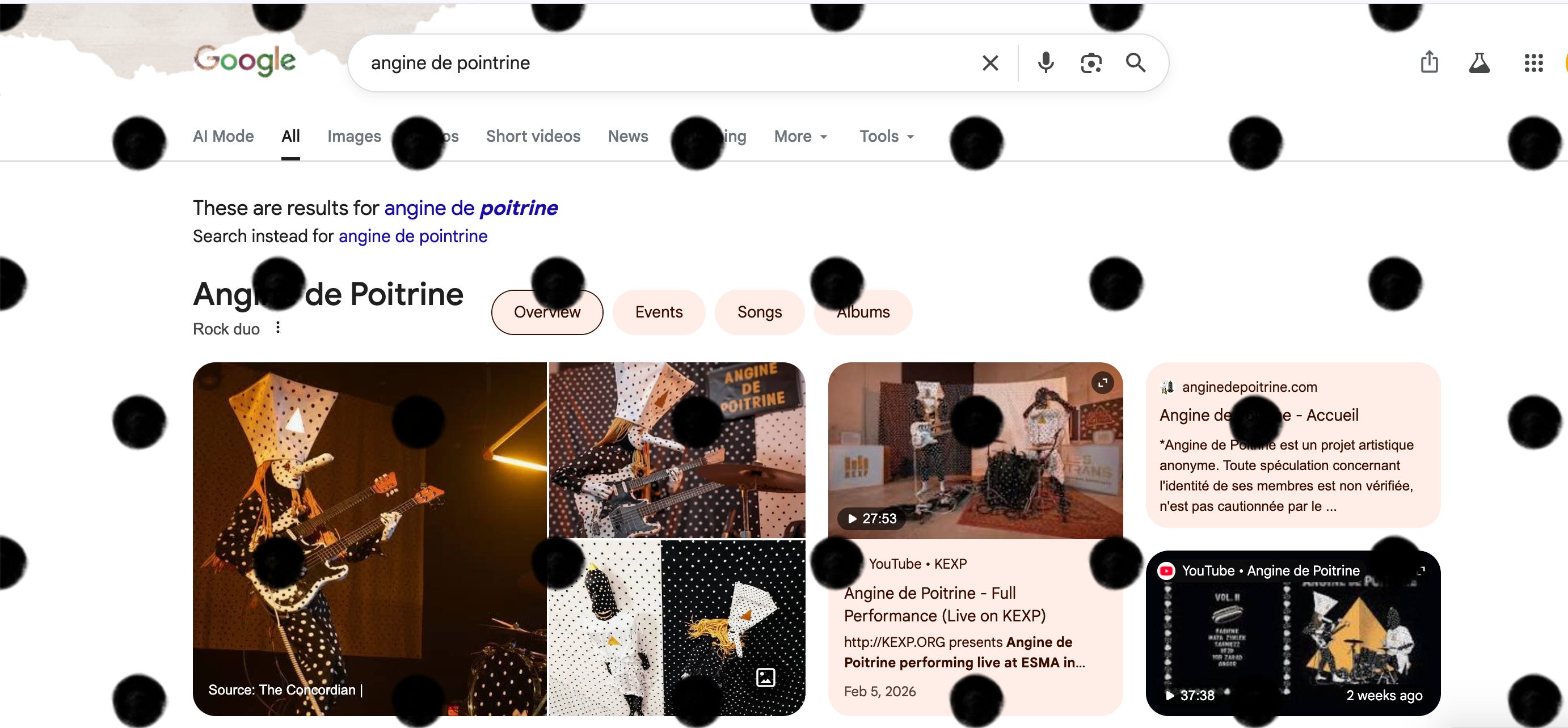
Finally got acquainted with music critic meme du jour Angine de Poitrine, a math-leaning jam duo from Quebec with some inspired novelty elements—polka dot outfits, bare feet, live looping with a double guitar/bass, ostensible microtones. It looks and sounds great live, and promptly goes limp on the record, which is sort of par for the course for this kind of stuff (see also: Reggie Watts).4 There is no dearth of bands doing time signature fuckery with nominal avant/classical trimmings (phasing, looping, ostensible microtones, whatever). This one was pretty good!
17. Green Cosmos: Kalimba Walk
Germany
None of the twisty turny sharp elbows stuff can compete with a kalimba used for basically any purpose, go fig.
18. Omar Sosa, Joo Kraus, Diego Pinera: El Comienzo
Cuba/Germany/Uruguay
19. Nightmares on Wax, Adrian Sherwood: Sweeter Still
UK
Two languorous cosmo-pop jams to cool down to a close—a jazz hangout that I enjoyed and a DJ chillout sesh that I mostly just abided, but both worked well for the mix dismount.
20. Jon Bastiste, Josh Harmon: Song of Storms
US
A little post-script bonbon from a viral video that turned up in my playlists afterward. I won’t say this is anything more than a Leo-finger-pointing novelty for people who like silly jazz improv and already know the song from Ocarina of Time, but I am one of those people. I have also confirmed that I can actually play this! (And that I need to get my piano tuned and practice more!) Koji Kondo made things easier for me by composing everything around notes in a D Dorian scale, an easy key to improvise in. I wrote a bit about the Zelda soundtrack last year in this post.
That’s it! Until next time, practice!
—Dave Moore (the other one)
Title from Courtney Barnett: Mantis
This is a brief snapshot of songs that appear in the Hot 100 or Global 200 Excl. US in the last two weeks, based on a song peak of #25 or higher. I may have missed some. But most of the big US pop hits during this period have comparably high placements on both charts (within at least 10 slots).
Technically the gap is tied with Don Toliver’s “E85,” which has an identical 85-point gap (15 to 100). But I’m giving the edge to Langley for placing higher on the US chart.
I’ve been using the Billboard Artist of the Year lists as a shorthand for time-limited zeitgeists, capturing US popularity within a particular year as a kind of time capsule measure. Morgan Wallen, Luke Combs, and Zach Bryan have appeared numerous times on the Artist of the Year lists since 2020—Wallen is bigger than Michael Jackson and Madonna by this metric, which tells you more about the metric than about Wallen. (I talk about why I use the measure in this way in this post). But all three of them have little to no impact on the GXU.
As far as I can tell, they are also the only artists in the ‘20s who have a chart impact like this. The really big breakthroughs from rap radio on the Artist of the Year lists—ones that I think do not make particularly strong overtures to pop radio—do reasonably well on the GXU (Roddy Ricch, Pop Smoke, and Lil Baby are all pretty close to their US placements with their big hits).
I also discovered that if you google the band now, this happens: