

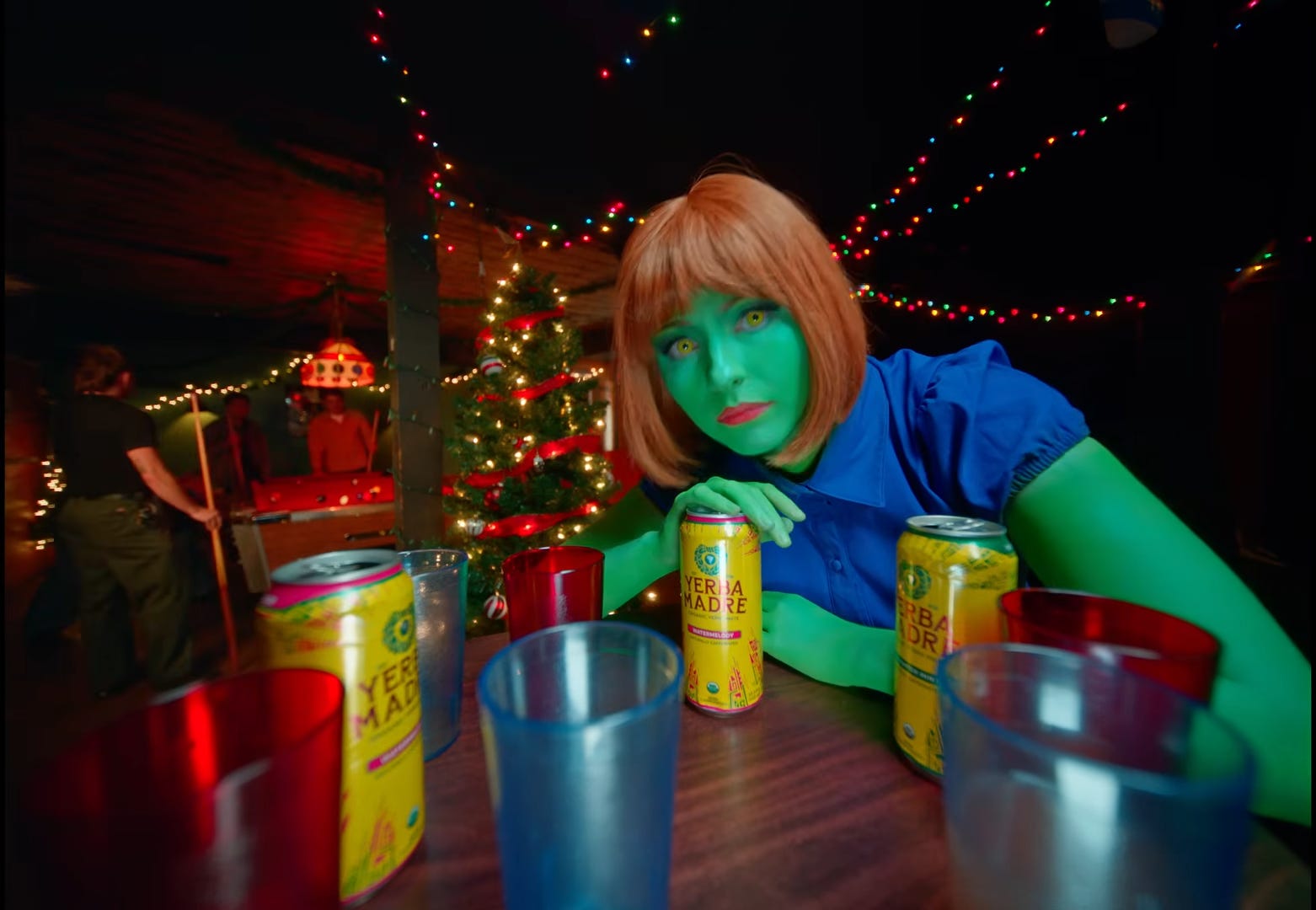
Had the opportunity to revisit Britney Spears and will.i.am’s “Work Bitch!” while I was putting together my list of songs of the 2010s. When it came out, I gave it a [10] at the Singles Jukebox:
will.i.am is such a dork, we all knew that, but more importantly Britney Spears is such a dork. I think that is wonderful, that we have such a huge dork in the fifteenth year of her unabated music career still blowing up planets and laughing with a little snort at the end (fun fact: Britney Spears is about as far along in her career now as Madonna was when Britney Spears debuted). But mostly I think this song is wonderful, this bluntest instrument in an era of very blunt instruments, bashing everything up not because it’s better (though it is) or because it’s dorkier (because it isn’t) but because these dorks are the biggest dorks, a distinction they have both earned, damn it.
Since that time, a somewhat compelling but unproven theory came out that Britney Spears is not (or is barely) singing on the track, and that the bulk of the song, along with other songs from Britney Jean, was recorded by her backup singer, Myah Marie:
The demo sounds pretty similar to the recorded version, where Myah is credited as backup. The question is whether the vocals are entirely Myah’s. There’s a comparison track—Britney Spears re-recorded the song for her Vegas residency, with those vocals isolated and then matched with the original instrumental:
I am not committed enough to this question to break out the waveforms or spend too much time parsing microscopic differences. The two different vocals already sound pretty similar, and I also don’t know exactly what I’m hearing in either of those original clips to begin with.
The question that I’ve been wrestling with, though, is how much I would even hypothetically care about whether or not Britney Spears is actually singing the original “Work Bitch.”
Although many things about the current wave of A.I.-generated music seems like hype, or like people over-reading the direction of a new technology too early in its mass adoption, the technology’s ability to copy voices is improving rapidly, and at some point A.I. generated voices of celebrities will probably be indistinguishable from a recorded vocal.
Just as an example of where the technology is at right now, Holly Boson created this Taylor Swift song with the following prompt: “A Taylor Swift song from the late 2010s or the early 2020s about performing massive environmental damage by rolling coal in a private jet, spraying cans of hairspray outside while yelling, using generative AI to come up with songs, and so on.”
I wonder if A.I.-generated voices will be used to augment or replace vocals from artists, in a way that’s indistinguishable from tried and true practices like stitching together multiple vocal tracks, slathering on vocal effects, or stacking on sound-alike back-up singers. And the question is whether I’ll care about this in the same way I care about the possibility that Britney Spears does not actually appear on “Work Bitch.”1
But the thing is, I can’t really work out how much I care about whether that’s actually Britney singing. I only know the answer is definitely not “I don’t care at all.”
A lot of things that feel like values in music-listening turn out to be relative assessments that are at best only true in a plurality of cases. In some instances these may be like value phantoms—that is, things you think you might believe until something forces an exception or reveals a contradiction that causes the whole house of cards to tumble down. For my part I try to steer clear of saying anything too definitive when I genuinely don’t know how I feel about something, or if I have never had reason to think about it.
At some level, all music is a magic trick: signifying personality from performance, tools of obfuscation and polish creating something that is realer than the thing “under” the thing—what you hear is what you get. I care deeply for how things sound and what they seem to convey, and I often don’t get too hung up with the documentary technicality of their construction, which might be illuminating or might be totally beside the point. There are songs whose evidence of creation deepens the impact of what the song is doing, and also songs whose resonance totally defies the boring, accidental, or tawdry reality of their creation. It usually doesn’t bother me, or at least not consistently.
But the Britney thing bothers me. And a lot of the A.I. stuff bothers me, too. I certainly feel differently about generated songs than I ever did about, say, AutoTune or synthesizers or samplers, which I always viewed entirely as production tools. I found skepticism or hostility toward them baffling. In fact, I would say that the further extremes of electronic manipulation have often brought out the humanity in the music they produce—like Autotune becoming a primal squeal, or synthesized instruments ignoring verisimilitude to let their various freak flags fly. But maybe there will be more exceptions with A.I., too, and I just haven’t grappled with them yet.
1. Georgia Maq: 10 Drunk Cigarettes
Australia
I always doubted that “10 Drunk Cigarettes,” the ostensibly A.I.-generated viral novelty from 2024, was actually a fully A.I.-generated song. At the time, I figured A.I., if used at all, may have horked out the lyrics and provided the vocal from a guide track. I didn’t think that A.I. song generation alone could produce a song with such “good bones.” By now I think it probably could, but interestingly I don’t know if the resulting song would be “bad” enough to be so good. Anyway, the song’s pristine skeletal structure is on full display in this crackling cover from Georgia Maq of Camp Cope (h/t to Jacob Sujin Kuppermann). An early A.I. era “standard,” maybe, along with “BBL Drizzy” and Frank Sinatra’s “Cruel Angel’s Thesis”.
2. Hannah Jane Lewis: Consolation Prize
UK
If you need it realer, here’s one of two realer-than-real (neither complimentary nor derogatory) country songs via Don’t Rock the Inbox this week, though this was the only one I remembered was from them (i.e. didn’t pick it out of the blindfold taste test). Natalie at DRTI singles out the line “heard you rode the Bitcoin train to the bottom/ don’t know when to quit boy, that ain’t my problem.” I also like this week’s title bad news coming out of the woodwork. (I imagine it emerging like the girl in The Ring.) There’s more, across a whole EP.
3. Anna Calvi f. Iggy Pop: God’s Lonely Man
UK/US
I am a perennial sucker for both schaffel-stomp and Iggy Pop guest appearances (his old Teddybears feature could have used a dollop of swing), so Calvi doesn’t need to do much to make this work. She holds her own trading lines and does a fun register swap in the chorus.
4. Lydia Képinski: À l’extérieur
Canada
5. Vamo: Des heures au tel
Canada
Two from Montreal: first, electro that is a combination of chintzy and blunt that sounds practically Eastern European (complimentary), and then some nice sing-rap on a clave base.
6. Javi Wayne, Anto Bosman: Hello Kitty
Chile
Campy reggaeton-pop (skews a little closer to dembow, maybe?) from Chile that retains the kawaii spirit of Hello Kitty while also defiling it. Frank Kogan recently had some musings on “neocute” (“i.e., claiming to reclaim cuteness as empowered choice”) which I don’t know if this qualifies as, but I think isn’t unrelated to.
7. Prod.Nifour, Mc Gw, Cacau Chuu: Ela ké Leitada
Brazil
8. Menor Teteu, MC Menor MT, DJ J2: É Só Prainha
Brazil
Two funk picks this week—blown-out brega funk fun with utility player Mc Gw and twice-mixed Cacau Chuu, then Menor Teteu gives “Glad You Came” by The Wanted a defib.
9. pinponpanpon: Pon Direction [2025]
Japan
Despite featuring several batshit pinponpanpon tracks last year, I somehow missed this one from October, where they hold Paris hostage with a baguette.
10. Amayajane, Zae: Spend That
Philippines-US/Philippines
Filipina rappers go way recessive in surroundings but not performance and give a sense of overshooting the mark. Normally this is something that requires some alchemy between vocals and production (like Cassie with Ryan Leslie, say) but here it works on personality alone (barely).
11. Bad Gyal, Chencho Corelone: Choque
Catalan/Puerto Rico
Catalan neoperreo star Bad Gyal with a straightforward scorcher.
12. Lestef KJF Boyz f. Dj Luchshiy: TAKE UR TIME
Guadeloupe
Have finally started backing up my mixes in earnest after figuring out how to mostly automate the extremely tedious process. I’m through 2023 and heading into 2024, and so far I’ve only completely lost two songs: The Emillio and Vagif Nagiev’s light EDM remix of “Azerbaijan” by Muslim Magomayev; D’Athiz, Ke-nny, and Locomeister’s quantum sound “Gumba Fire.” A third song I thought I’d lost: a Nigerian mara (street rap) song by Professional Beat, “Aye lo so (mara),” but I did find a copy of it eventually—in fact, while I was writing this.
Professional Beat, “Aye lo so (mara)”
There are another 10-20 songs I had to similarly reconstruct from other places because they’re off of the major streamers. All of this is to say that I need to be a bit more timely and diligent about the backups, especially for local scenes and songs that originate on Soundcloud or seem to be on wobbly copyright grounds. My guess is that this designation might include crackerjack bouyon remixes of Madonna hits, already only available on YouTube as a session video.
13. 林詩雅Grace f. HUR+: Refund
Taiwan
Taiwanese girl group recommended by Iain Mew, though this particular song—a highlight from their album 9of9 Arcana—seems to be credited as a solo by Grace Lin. Maybe they’re doing their BLACKPINK and post-BLACKPINK careers simultaneously?
14. Haku.: ふわ輪 [Fuwa wa]
Japan
Dubdobdee fave Haku. is back…BACK! as they seem to be every few months. Tuneful J-rock power pop.
15. Luizga f. Faew: A Caverna Ligou No Wifi
Brazil
Gilberto Gil-minded singer/guitarist teams up with (from what I can tell) a backpack-minded beatmaker and create something with electronic logic and mostly acoustic sounds.
16. Cazzu: Jujuy Estrellado
Argentina
Cazzu is a huge star I don’t follow very closely; I can’t tell how much her somewhat traditionalist bent in the past year or so echoes other parts of her career—I first heard her on charming trap-pop hit “Chapiadora” in 2018—but this one splits the difference a bit, feels intriguingly out of time.
17. Ashs The Best: Weeruway
Senegal
Have rustled up a few more Senegalese pop playlists and found this lovely ballad, a wash of harmonies sounds great in counterpoint to the wandering guitar line.
18. Yemi Alade: My Bébé
Nigeria
Yemi Alade is always dependable, was reminded that she’s been a pretty big deal for over a decade now when Jonathan Bogart shared “Bounce” in his songs of the ‘10s countdown. (His countdown points toward the ‘20s in a way that mine shies away from them; should go back and do some revisionism at some point with more of a post-A-pop mindset.)
19. IKITSUKE, Toshiyuki Yasuda, Sala: MSA
Japan
Bringing the mix in for a landing with a light Japanese ballad that forces the horn arrangement behind the singer to muffle themselves with pillows.
20. Naïma Frank: Ainsi soit-il
Haiti-Canada
Montreal is bringing it this week, very cool kitchen-sink art pop that pins its various ideas to a serviceable Jersey club throb.
21. Luka Salam, Hadi Birajakii: Toute - توت
Egypt
Egyptian pop goes Latin-tinged songbook, but it can’t stay on the same page of the book and whirls through a few other jazz-pop styles, ending somewhere in Paris, probably well clear of pinponpanpon.
22. August Ponthier: Everywhere Isn’t Texas
US
Didn’t realize this was recommended in the same Don’t Rock the Inbox newsletter as Hannah Jane Lewis, but will pass the recommendation karma on to Hannah Jocelyn, who just reviewed the album in Pitchfork. I appreciated the audacity of the musical quote that Hannah singles out in her conclusion:
On paper, the title track and its reprise take that sentimentality too far: Even given The Wizard of Oz’s historical significance to the queer community, it’s risky for an artist to interpolate “Somewhere Over the Rainbow” in 2026, and riskier still to do it twice. Yet these tracks do that while also getting across the album’s central dilemma: Do you flee your home when it’s getting too dangerous, or do you work on making the place you’re from better? Do you come out, or do you stay safe? The first song flees for greener pastures; the second song digs its ruby heels in, with a message that seems directly aimed at the trans teens who will likely find this record: “Everywhere isn’t Texas/’Cause the words and laws they wrote/Couldn’t touch our soul.” It’s achingly optimistic about the future of trans people without being naive. Ponthier doesn’t always strike the right balance of mischief and melancholy, but when they get it right, the mix is disarming.
Happy to let that be the last word. But I will take the opportunity to link one of my favorite “Over the Rainbow” interpolations — more of a passing resemblance —On!Air!Library!’s “Bread.”
That’s it! Until next time, go dig up your old On!Air!Library! records, I guess?
—Dave Moore (the other one)
Title from Hannah Jane Lewis: Consolation Prize
The umbrella of “A.I.” is as annoyingly broad for music production as it is anywhere else, so some distinction between uses is probably necessary. I think the potential and pitfalls for A.I. in restoration processes is already pretty well established. I also think the use of vocal generation for the purposes of parody and memes is different from deceptive use. I’ve heard A.I. generated reconstructions of unused lyrics from rappers to suggest what the verse might have sounded like, which, if presented with that context, feels closer to music criticism than impersonation. Seems like treacherous territory, though.
Apple Music has wreaked havoc on my baile funk playlists from the past few years. I assume they've taken down some of these songs for including uncleared samples.
"these may be like value phantoms—that is, things you think you might believe until something forces an exception or reveals a contradiction that causes the whole house of cards to tumble down"!!