

It’s vacation time, so this week and next will be recaps. We are at the halfway point of the year, so I thought I’d highlight a bunch of songs and writing of the year so far. Next week will be the monthly June roundup along with my albums list.
Best Songs
Here’s my ongoing best songs of the year playlist, ranked for the first 20 and then just added on as they come.
Best Words
I’ve written a bunch of things I’ve liked so far this year, but have stalled on my planned series on Disney-pop. I think I’m a little too close to it—I’ll probably sit on it for a while, or maybe move on to something else.
—A.I. and fakery: “A lot of things that feel like values in music-listening turn out to be relative assessments that are at best only true in a plurality of cases. In some instances these may be like value phantoms—that is, things you think you might believe until something forces an exception or reveals a contradiction that causes the whole house of cards to tumble down. For my part I try to steer clear of saying anything too definitive when I genuinely don’t know how I feel about something, or if I have never had reason to think about it.”
—Slapdash canon-making: “My sense is that some version of ‘pop music’—most of which really falls under the umbrella that I’ve been calling A-pop—is going through something like its indie phase. What’s important about that distinction is that it’s an audience distinction more than an artist distinction, per se. The rock canon of indie sites in the early aughts didn’t only comprise ‘indie acts,’ but conversations about every act was ‘indie’ because of the weird way that they distorted history to make a selective crop of minor contemporary artists feel worthy of sharing that same canon.”
—Regional US music: “When I talk about A-pop, I am not really referring to a regional form of music that is mostly popular within the US. I’m instead thinking about still-globally-minded US pop music seeming trapped in a battle against many other regional competitors for everyone’s attention. But I wonder if this sort of US regionalization is a related phenomenon. There are many forms of US music that haven’t always traveled well, but what seems different is that these types of more localized music are showing up in measures of listener accounting that tend to be more globalized. That is to say, the Hot 100 is perhaps taking on the characteristics of a more regional chart, one that may get more local and idiosyncratic as time goes on.”
—Afrobeats and the perils of “regional” pop: “A regionalization perspective suggests that regions will cyclically come in and out of fashion in unpredictable ways. The main thrust of the A-pop series was that the US itself has to be thought of now as one of many regional competitors, and that US pop music specifically doesn’t have a history of being framed in this way. But the flip side is that different regional styles will also rise and fall, and that it’s hard to know when and why precisely, because the global landscape has changed so much so quickly.”
—Modern melodic pop or lack thereof, a piece where I describe common melodic strategies for weak melodies that help songs get more words across with less effortful melodic construction. The strategies I name are intuitive coinages but I do think there is a bigger story I’m getting at with this one that might bear some more thought and writing.
—CAPDY, GAPDY, and “critical convergence” as critical erosion. CAPDY stands for Charli XCX, Ariana Grande, Disney expats (Olivia Rodrigo and Sabrina Carpenter), and SlaYYYter. It’s a play on GAPDY, a group of 2009 critically lauded albums: Grizzly Bear, Animal Collective, Phoenix, Dirty Projectors, and Yeah Yeah Yeahs. “In 2026, it’s the US and Anglosphere capital-P pop albums that seem weak and safe to me, clustering in conversations while being far less interesting than those conversations would lead you to believe—though it’s too early to say if any of this will correspond to year-end lists. It’s not that there’s nothing to recommend any of the albums. Just like with GAPDY, I like some of them just fine, and dislike others. It’s more that the focus on these albums seems to ignore all of the other places where the action really is.”
1. Debbii Dawson: Where Have All the Good Men Gone?
US
I singled out Debbii Dawson as an exceptional melodic writer. What this song reminds me of most is Marit Larsen—and not in a half-remembered borrowing way. I like that she leans on ABBA the same way Larsen did, not just as a pastiche but as foundation for her own personality (which is where I think she and Marit Larsen differ considerably). I have a lot more to say about Dawson and her role (or lack thereof) in the current A-pop ecosystem, but will maybe save it for after her EP drops tomorrow.
2. Big Freedia, SOPHIE: Blaze That Ass
US/UK
There is now a formal EP of the collaborations between Big Freedia and SOPHIE, including this song, which has been floating around on the internet since they recorded it in 2016. They sound great together.
3. Baauer: Calling Out for U
US
Baauer surprised me by putting out an incredible post-Flume pop dubstep album in 2016, three years after his breakthrough with “Harlem Shake.” And now he’s surprised me again ten years after that with a bright dance-pop album that might make my albums list again. It features lots of songs with Nigerian rapper Brazy, who seems like the Marta to his Tricky, a late period muse. This one doesn’t feature her, though; it’s just a sample of Cherelle’s “The Right Time” squeezed for every last drop of juice.
4. Maya Jane Coles, Rye Rye: Rise Up
UK/US
Speaking of promising early ‘10s personalities, I’m glad that Maya Jane Coles found some room for Rye Rye here. Her hopscotch flow sounds counterintuitively great against something this smooth.
5. Lvbel C5, Mohamed Ramadan: Pss Pss
Turkey
A major Turkish rapper whom I have featured before. I usually find him kind of lumbering, but setting him against dembow bounce creates an interesting counterpoint.
6. Aygün Kazımova: Məclis
Azerbaijan
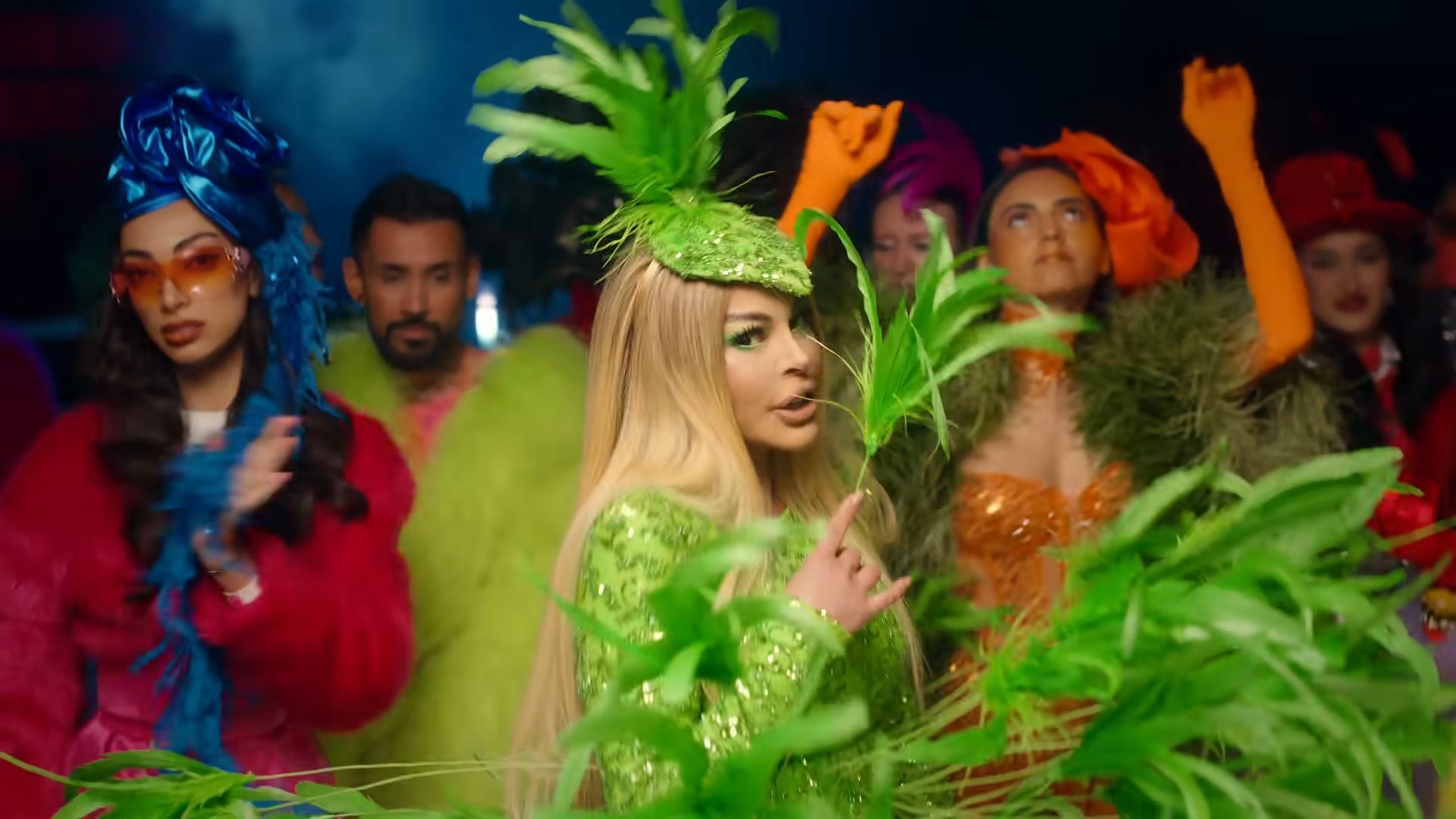
An Azerbaijani diva barely brings herself above a whisper, but still manages to command dancers across circus set pieces and tigers through flaming hoops.
7. ANSTAY: Кажу Ні [Kazhu Ni]
Ukraine
Ukrainian pop shifts seamlessly from rubbery hip-hop into half-speed phonk.
8. Eloise Pezzner: Head
US
An early Billie Eilish-esque single for an early Billie Eilish-esque person. Which is to say she was born in <checks notes> 2010. I need to lie down.
9. A Certain Ratio: Lucinda (EM)
UK
This is the second appearance of A Certain Ratio on one of my mixes, and the second time I’ve thought “isn’t this a British post-punk band from the ‘80s” only to hear music that in no way corresponds to what I imagined I knew about them—this time out, loose indie disco. (I went back and listened to their older music and I’m probably thinking of a different band.)
10. B0YG1RL, NOVAGANG: My people will destroy you
Haiti-US/US
So this one poses a bit of a sticking point for me—I really disliked it on first listen and particularly disliked the arty framing it got in Pitchfork. I think that its avant hipster tendency to reduce global sounds to capital-N noise not only misses the spark in those sounds but often misses even the noise, like tuning your vacuum cleaner. The roughness—signifying as such—bothers me, because it’s too smooth, or smooth in the wrong way, like a rock tumbler’s artificial sea glass.
It has also helped me understand why Manny Farber included Jules et Jim in his White Elephant Art essay, a choice that made me lose the thread a bit when I first read it, because I found Jules et Jim scrappy and charming myself. There’s something about the totalizing control exhibited over this work that smothers the little embers—in performance, in rhythm, in noise—trying to fly out. In fact, the way Farber describes Jules et Jim is not far off from my thoughts about the album: “Jules et Jim, the one Truffaut film that seems held down to a gliding motion, is also cartoonlike but in a decorous, suspended way.”
But at the end of the day my body doesn’t reject this thing outright even though my brain is pretty convinced it’s right about this. Maybe it’s just a brain problem.
11. DJ SKYCEE, Miimii KDS, Lucky Iukee: Bodé
Guadeloupe
No brain judo necessary to enjoy another follow-up from the “Se MiiMii” team, which to be fair to them, was also Pitchfork-championed (by a better critic). It’s pretty good!
12. DJ Yams, L’as Biass: Chargée
France
Jonathan Bogart on Bluesky: “afro french pop is so caribbean in 2026: everything that isn't bouyon is konpa,” to which I responded “(complimentary).” I suppose you could also add shatta to the list. This has the annoying side effect of making it harder to source where exactly the low-stream artists come from, since “France” listed on streaming often means French Antilles. I think I confirmed it’s really France for this duo, though—at least for L’as Biass, who’s from Mantes-la-Ville according to his Instagram.
13. Bloody Civilian, Terry Apala, Boj: SpaceFuji
Nigeria
I’ve been trusting Lokpo to suss out emerging post-Afrobeats sounds in Nigeria. This one is maybe borrowing a bit from South African house styles but it avoids the now well-worn amabeats pipeline. Not to sound too much like Oblique Strategies, but when in doubt, try incorporating SPACE.
14. Ba Bethe Gashoazen, Nova sa style f. Westboy, Caeser, DJ Janisto: Skhethe
South Africa
15. PLG Chanty, Focalistic, King Master: Stofi Stofoza 2.0
South Africa
Two from a quick visit to the South African charts, which always nets great selections that I’ve missed or maybe just stuck onto a holdover list at a glance. Both of these lean away from amapiano proper, toward a brighter pop sound and gqom, respectively.
16. Chi Pu: Mirror
Vietnam
Vietnamese pop is really exploding right now—has been for a while, but at this point I’m almost guaranteed to find something I like every week without seeking anything out.
17. Leyla Ebrahimi: I’m a Little Flower
US
This is the part where I tell you about a song and/or artist that sounds like what I imagine Olivia Rodrigo is going for, but does it better at every level from production to melody to vocals to words. So this is maybe the part where you descend into the comments to tell me I’m nuts. If I’m right about this, which I probably am not, history will eventually vindicate me that Olivia Rodrigo was a middling pop star but a decent senator.
18. KUOKO: Miss You
Germany
Hamburg-based artist also beats Olivia Rodrigo, maybe not at her own game, but in showing other avenues for getting your confessional lyricism across without falling into gloopy synth traps or a generic approximation of indie jangle. My first thought was “thank god, who is the producer?” only to find that she is the producer. Maybe Rodrigo’s next step for cred if she doesn’t run for office should be to namecheck Everything But the Girl and get in the studio with KUOKO. (If she really wants to swing for the fences, she should try budots.)
19. Adelin: Molt
Sweden
20. Robbie & Mona: Le Jardin de Linda
UK
I won’t claim that the two wispy closers are actually all that close to Olivia Rodrigo, but it is a reminder that there are countless good songs released every week that very few people pay attention to. Which you probably knew already if you made it this far in the newsletter. And to you I say thank you! Sometimes I don’t even make it this far!
That’s it! Until next time, get in the studio with KUOKO I guess.
—Dave Moore (the other one)
Title from Debbii Dawson: Where Have All the Good Men Gone?
I really like Debbii Dawson!! I think her lyrics are kinda holding her back—like your title song, with "I'm not woke I'm just tired / there's bills to pay and a genocide" or however it goes. But I love everything else.